
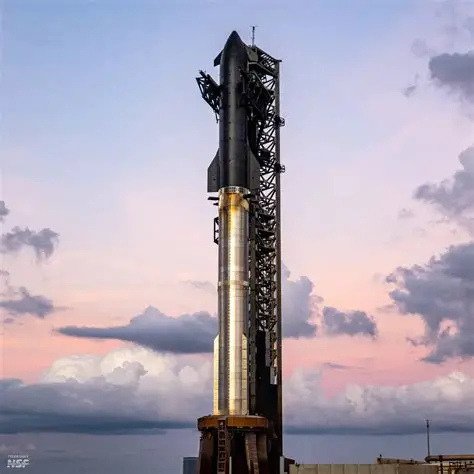
SpaceX made further progress in its Starship development programme on Friday, November 13, 2026, after its latest test flight successfully delivered 26 next-generation Starlink satellites into Earth’s orbit. However, the mission did not achieve all its planned objectives, as the Super Heavy booster failed to complete its scheduled recovery and was ultimately lost in the Gulf of Mexico.
The launch was conducted from SpaceX’s Starbase facility in South Texas at approximately 4:47 p.m. local time. The flight marked the 15th integrated test of Starship, the company’s powerful launch system designed to support satellite deployments, future lunar missions and eventual human exploration of Mars.
Following liftoff, the rocket’s two main stages performed their separation sequence successfully. The Super Heavy booster provided the initial thrust required to propel the upper-stage spacecraft, identified as Ship 42, toward orbit before separating and beginning its return journey.
Meanwhile, the upper-stage vehicle continued its flight and successfully released 26 Starlink Version 3 satellites. The deployment represented an important achievement for SpaceX as it works to expand its global satellite internet network. The upgraded satellites are expected to provide greater communication capacity and improve broadband connectivity for users.
The successful release also demonstrated Starship’s potential to transport larger payloads into space, an important capability that could make future satellite launches more efficient. SpaceX aims to use the rocket’s substantial carrying capacity to accelerate the expansion of its Starlink constellation.
However, the booster encountered difficulties during its return to Earth. SpaceX had initially planned to guide the Super Heavy vehicle back to its launch facility, where two large mechanical arms attached to the launch tower would attempt to capture it. The recovery mechanism, widely known as the chopsticks system, is designed to support rapid rocket reuse and reduce the cost of future launches.
The recovery operation was called off after the booster experienced a technical problem involving its guidance, navigation and control systems. Rather than continuing toward the launch tower, the vehicle was redirected toward a designated landing area in the Gulf of Mexico. It subsequently exploded before completing a successful water landing.
The unsuccessful recovery was a setback for SpaceX, particularly because the company had previously demonstrated successful catches of Super Heavy boosters during three earlier test flights. The latest mission involved an upgraded booster and was intended to further demonstrate the reliability of its recovery technology.
Despite losing the booster, the upper-stage spacecraft continued operating in orbit. Ship 42 was scheduled to complete approximately 14 revolutions around Earth at an altitude of about 170 miles before beginning its return journey.
Another major objective involved attempting to recover the Starship upper stage using the launch tower’s mechanical arms. Achieving this would represent a major advancement because SpaceX ultimately wants both stages of its rocket system to be reusable. As of Saturday, November 14, the upper-stage recovery attempt remained part of the planned mission.
The test flight also has wider implications for NASA’s Artemis programme. Starship is being developed as a human landing system intended to transport astronauts to the lunar surface during future missions. Its development is therefore important to America’s broader ambitions for renewed human exploration of the Moon.
SpaceX founder Elon Musk has repeatedly highlighted the importance of reusable rocket technology, arguing that it could significantly reduce the expense of space transportation and make launches more frequent. The company also intends to use Starship for larger satellite deployments and eventually missions to Mars.
Although the booster loss prevented the mission from achieving a complete recovery of both rocket stages, the successful deployment of 26 Starlink satellites represented a notable accomplishment. The flight also provided engineers with additional information about the rocket’s performance and the challenges associated with bringing its components safely back to Earth.
SpaceX continues to refine Starship through repeated test flights, using the results to improve its launch systems, recovery procedures and overall reliability. The latest mission demonstrated continued progress while highlighting the technical obstacles that remain before the company can achieve fully reusable space transportation.
You can watch the video below