
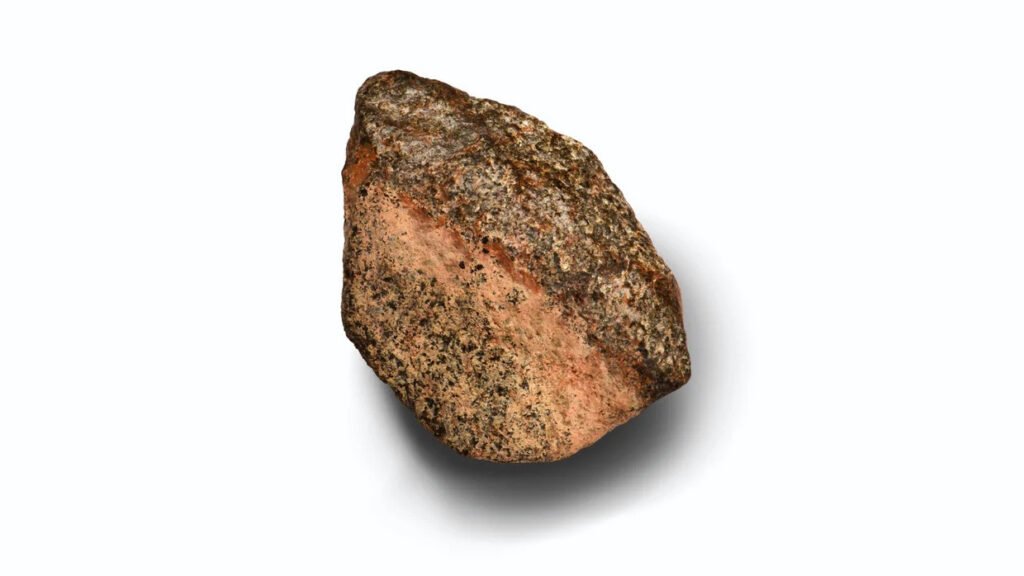
A remarkable discovery in the Sahara Desert has provided scientists with a rare opportunity to investigate the ancient geological history of Mars. A rose-coloured meteorite recovered in Mali has been identified as a fragment of the Red Planet dating back more than 4.1 billion years, offering fresh insights into its early crust and the possible presence of water during its formative period.
The unusual specimen, identified as Teghaza 001, was discovered in 2022 on a salt plain in Mali, West Africa. Weighing approximately 800 grams, the rock initially stood out because of its distinctive pinkish appearance. Subsequent scientific examinations, however, revealed that its importance extended far beyond its unusual colour.
Researchers conducted detailed mineralogical and chemical analyses to establish the meteorite’s origin and age. Their findings, published in the scientific journal Science on October 29, 2026, identified the specimen as one of the oldest known Martian meteorites recovered on Earth.
Laboratory investigations revealed that Teghaza 001 formed at least 4.1 billion years ago, during an important stage in Mars’ early geological development. The sample contains volcanic minerals and microscopic zircon crystals that preserve information about the conditions under which the original rock developed.
Scientists used advanced dating techniques to examine the mineral composition and establish the specimen’s geological history. These analyses also indicated that liquid water interacted with some of its minerals approximately 4.1 billion years ago.
The discovery is particularly important because it provides evidence of water-related geological activity during the early stages of Mars’ evolution. Researchers believe the interaction between water and volcanic materials could help explain how underground environments developed on the planet billions of years ago.
The meteorite’s mineral structure also offers clues about the formation of the Martian crust. Its composition suggests that volcanic processes played an important role in shaping the planet’s early surface before subsequent geological changes altered its characteristics.
Another interesting aspect of the research involves the specimen’s possible geographical origin. Scientists compared its chemical characteristics with geological observations collected by NASA’s Mars Reconnaissance Orbiter. Some of its features resemble materials identified in the ancient southern highlands of Mars, although its precise location of origin has not been established.
The specimen is especially valuable because ancient Martian material is difficult to obtain. Although hundreds of meteorites originating from Mars have been identified on Earth, only a small number preserve evidence from the planet’s earliest geological period. Teghaza 001 is considered one of the three oldest known examples.
Researchers believe the rock originally formed within Mars before a powerful impact launched it beyond the planet’s surface and into space. After travelling through the solar system, the fragment eventually reached Earth and was recovered in the Sahara region. The exact date of its arrival remains uncertain.
Beyond understanding the planet’s geological development, the findings could contribute to ongoing research into whether ancient Mars once supported conditions suitable for life. The evidence of water activity is particularly relevant because liquid water is considered essential for life as currently understood.
Nevertheless, scientists have not established that the meteorite contains evidence of ancient organisms. Its importance lies primarily in the geological information it preserves about the environmental conditions that existed on Mars billions of years ago.
Further investigations could help researchers understand the relationship between volcanic activity, water circulation and the development of the Martian crust. The findings may also assist future exploration missions in identifying locations where ancient geological evidence could be preserved.
The discovery of Tehama 001 offers an unusual window into Mars’ distant past. By examining a small fragment that travelled millions of kilometers before reaching Earth, scientists are gaining valuable information about how the Red Planet evolved from its earliest stages into the dry and cold world known today.
You can check the video below