
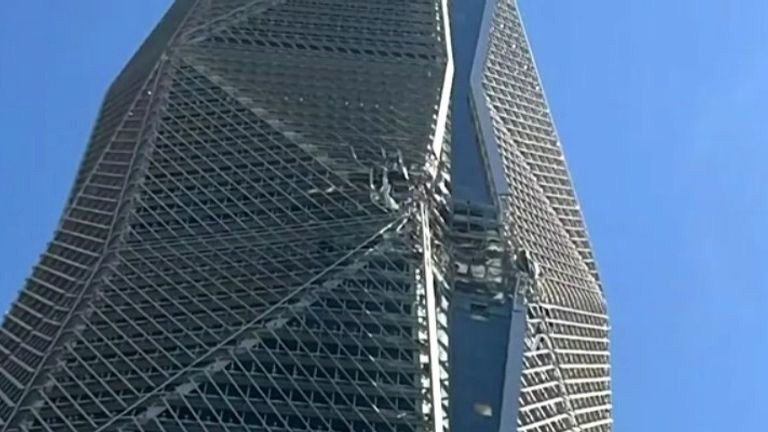
Saudi Arabia’s capital has witnessed another alarming security incident after its tallest skyscraper sustained damage in an attack reportedly carried out by Yemen’s Houthi movement. The incident involving the Public Investment Fund (PIF) Tower in Riyadh has heightened concerns about the security of major commercial properties as tensions across the Middle East continue to intensify.
The strike took place on Thursday, November 19, 2026, targeting the 80-storey building situated in Riyadh’s King Abdullah Financial District. The skyscraper serves as the headquarters of Saudi Arabia’s Public Investment Fund, a major financial institution responsible for supporting the kingdom’s ambitious economic development plans.
Saudi civil defence authorities reported that the incident caused material damage to the tower and surrounding buildings. Despite the impact, no casualties were immediately reported. Emergency personnel were sent to the area to assess the situation and ensure public safety.
Reports indicated that the attack shattered windows across several floors, with damage affecting approximately seven to eight levels of the skyscraper. Parts of its exterior metal facade were also reportedly bent or damaged by the impact.
Following the incident, security officials restricted access to sections of the King Abdullah Financial District and evacuated people from nearby buildings. Emergency response teams, including fire services and ambulances, were deployed as authorities began examining the extent of the destruction.
Sources familiar with the situation told Reuters that an incoming missile launched by the Houthis had struck the building. The Saudi-led coalition also reported responding to a missile threat directed towards Riyadh. Its preliminary assessment suggested that falling debris had contributed to the damage, although further investigations were required to establish the full circumstances.
The Houthi movement subsequently claimed responsibility for targeting Riyadh’s financial district on two occasions during Thursday. The group also announced attacks against additional Saudi locations, including King Khalid International Airport, a military airbase in the southern region and a petrochemical facility in Jubail. However, the additional claims were not immediately independently verified.
Saudi Arabia strongly criticised the incident, with its Foreign Ministry warning that the country would take necessary measures to defend its territory, protect its population and safeguard important national infrastructure. The government has also faced increasing pressure to strengthen security arrangements around strategically important locations.
The latest incident comes shortly after another building associated with Saudi Arabia’s oil industry reportedly sustained damage in a separate attack. On November 8, a Saudi Aramco property in Riyadh’s financial district was affected, raising further questions about the vulnerability of important business facilities.
The PIF Tower is particularly significant because of the institution headquartered inside it. Saudi Arabia’s Public Investment Fund manages substantial financial resources and serves as a central component of Crown Prince Mohammed bin Salman’s Vision 2030 initiative.
The economic transformation programme seeks to diversify the country’s economy beyond oil production by expanding sectors such as tourism, entertainment, technology, infrastructure and international investment. The fund supports numerous large-scale development projects designed to attract global businesses and strengthen Saudi Arabia’s position in international markets.
Damage to such a prominent financial institution’s headquarters therefore carries implications beyond the physical destruction of the building. The incident could also raise concerns among international investors about the security of operating businesses and infrastructure in the kingdom.
Saudi Arabia has invested heavily in developing Riyadh into a leading regional centre for finance, commerce and international events. The repeated targeting of prominent locations could complicate those ambitions and increase concerns about the wider economic consequences of regional instability.
The latest confrontation also reflects the continuing tensions surrounding Yemen’s conflict. The Houthis, an Iran-backed armed movement controlling significant parts of Yemen, have repeatedly carried out missile and drone operations targeting Saudi interests.
With the regional security situation remaining uncertain, authorities are continuing to assess the damage and monitor possible further threats. The strike on Riyadh’s landmark skyscraper has highlighted the challenges facing Saudi Arabia as it attempts to protect its economic infrastructure while navigating an increasingly unstable Middle East.
You can watch the video below