India amasung Nepal-na bilateral relationship hen-gat-hanba amasung economic cooperation strong touba-gidamak important agreements-sing sign toure. November 23-da New Delhi-ta India-gi Prime Minister Narendra Modi amasung Nepal-gi Prime Minister Balendra Shah-na bilateral meeting pangthoklammi. Meeting asida India-na Nepal-gidamak Rs 15,000 crore-gi economic assistance package announce toukhi. Countries ani-na eight Memorandums of Understanding (MoUs) su sign toukhi.
Package asi Nepal-gi August 2026-gi devastating flood amasung landslides-gi matungda reconstruction, infrastructure development amasung energy projects support touba-gidamak oiri. India-na Nepal-gidamak grant amasung credit support piba plan leiri. Leaders ani-na comprehensive joint vision document ama agree toukhi, aduda trade, energy, technology, education, healthcare, agriculture amasung transport connectivity yare. Ayodhya amasung Janakpur marakta Saryu-Kamala Express railway service su officially flag off toukhi. Asi India-Nepal relationship-gi future-gidamak significant development ama oiri.
Source: The Indian Express – India-Nepal joint vision document · Reuters – India announces $1.62 billion package for Nepal.
Marvel Studios has generated fresh excitement among superhero fans with the release of its latest trailer for Avengers: Doomsday. The preview, released on November 23, 2026, offers a closer look at the return of several familiar characters, including Steve Rogers, while introducing the growing danger surrounding Doctor Doom. The upcoming film is expected to bring together multiple superhero teams in a conflict that could have major consequences for the Marvel Cinematic Universe (MCU).
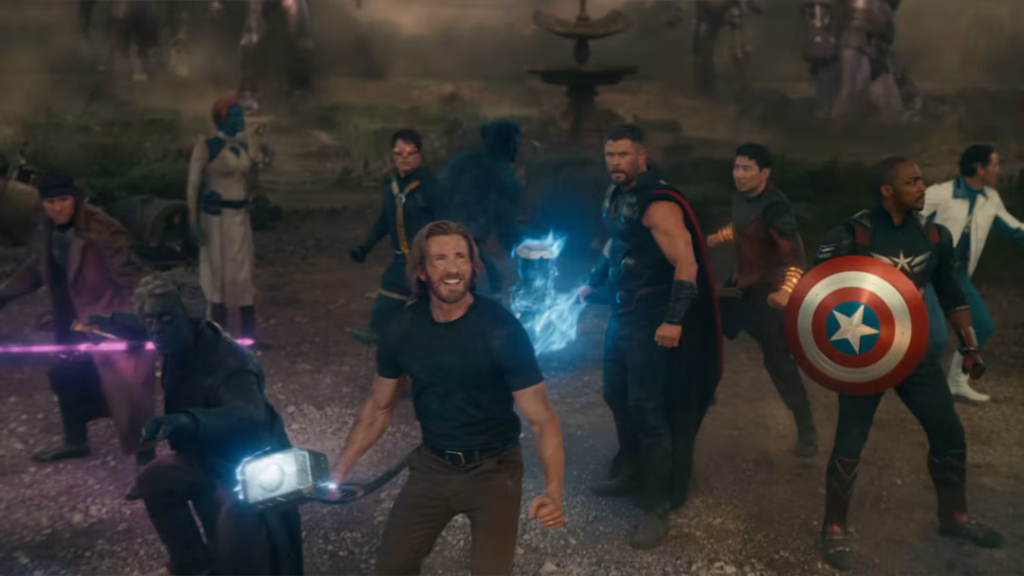
One of the most talked-about moments in the trailer is the appearance of Chris Evans as Steve Rogers. The former Captain America is shown living a relatively peaceful life with Peggy Carter, portrayed by Hayley Atwell, and their son. The scenes provide a glimpse into Steve’s personal life following the events of Avengers: Endgame, when he chose to remain in the past with Peggy rather than return to his previous responsibilities as an Avenger.
The opening sequence also explores the question of whether Steve’s son knows about his father’s history as Captain America. However, the family’s quiet routine appears to be interrupted when the Fantastic Four arrive at their home with an unexpected request.
Pedro Pascal, who plays Reed Richards, is shown approaching Steve and asking about his identity. The encounter suggests that the Fantastic Four are searching for assistance as an increasingly dangerous situation threatens multiple universes. Their arrival could mark the beginning of an important alliance involving heroes who have previously operated in separate worlds.
Steve’s involvement is particularly significant because his storyline appeared to reach a conclusion in the previous Avengers film. His return raises questions about what circumstances could bring him back into a conflict of such enormous proportions.
The trailer also offers another glimpse of Robert Downey Jr., who returns to the Marvel franchise as Victor von Doom, widely known as Doctor Doom. Previously recognised for portraying Tony Stark, the actor is taking on a completely different character in the upcoming production. Doctor Doom is positioned as the central antagonist, with his presence creating a threat that could require the combined strength of several superhero groups.
Several familiar teams are featured throughout the preview, including the Avengers, Fantastic Four, New Avengers, Wakandans and the X-Men. Their involvement suggests that the upcoming battle will extend beyond individual rivalries and require cooperation between characters from different timelines and universes.
Chris Hemsworth also returns as Thor, appearing in a scene where he encourages the assembled heroes to put their disagreements aside and work together. His appearance reinforces the importance of unity as the superheroes prepare for the approaching danger.
Another memorable moment features James Marsden as Cyclops delivering the familiar line, “To me, my X-Men!” The appearance of returning X-Men characters has added further excitement, particularly among viewers who have followed the franchise for many years.
The film features an extensive cast that includes Anthony Mackie, Sebastian Stan, Florence Pugh, Vanessa Kirby, Ebon Moss-Bachrach, Joseph Quinn, Tom Hiddleston, Paul Rudd, Channing Tatum, Ian McKellen and Patrick Stewart.
Directors Anthony and Joe Russo are returning to lead the project after previously working on Avengers: Infinity War and Avengers: Endgame. Their involvement has increased expectations surrounding the film’s large-scale action sequences and interconnected storyline.
Avengers: Doomsday is scheduled to reach Indian cinemas on December 17, 2026, with its international theatrical release planned for December 18. The movie will also help establish the storyline for the next major Marvel production, Avengers: Secret Wars, which is expected to arrive in December 2027.
With Steve Rogers returning to the superhero world, the Fantastic Four seeking his assistance and Doctor Doom emerging as a powerful adversary, the latest trailer has provided a glimpse of an ambitious new chapter in Marvel’s storytelling.
As the release date approaches, anticipation continues to build around how the different superhero teams will come together and whether they can prevent the growing multiversal threat from changing the future of the MCU.
India-gi Supreme Court-na Delhi amasung National Capital Region (NCR)-gi air pollution reduce touba-gidamak BS-VI emission standard fulfil touba vehicles khaktang allow touba proposal support toure. November 23-da Chief Justice of India Surya Kant-gi leadership-ta three-judge bench-na annual air pollution issue-gi maramda hearing toukhi.
Court-gi observation matung-inna BS-VI-compliant vehicles khaktang Delhi-da allow touba asi pollution control touba-gidamak effective measure ama oigani. BS-VI emission standards asi April 1, 2020-dagi India-da new vehicles-gi manufacture, sale amasung registration-gidamak mandatory oikhi. Court-na Punjab, Haryana, Uttar Pradesh amasung Rajasthan governments-singda NCR pollution reduce touba-gidamak makhoigi steps-gi maramda affidavit submit touba direction pikhre. Case asi November 25-da amuk hearing touba yai.
Source: The Indian Express – Supreme Court on BS-VI vehicles in Delhi.
Tesla is drawing fresh interest from financial analysts and investors as the electric vehicle manufacturer continues advancing its autonomous driving technology. The company’s latest Full Self-Driving (FSD) software update has attracted favourable attention from Wall Street, reinforcing expectations about its potential role in the future of artificial intelligence-powered transportation.
The company has started introducing FSD version 15, which includes several changes intended to improve vehicle awareness, road navigation and the interpretation of surrounding environments. The release represents another step in Tesla’s broader efforts to strengthen its position in the autonomous mobility industry.
JPMorgan analyst Rajat Gupta has expressed a positive assessment of Tesla’s progress, highlighting the company’s developments in consumer-focused autonomous driving. His comments come as other automotive manufacturers increase investments in artificial intelligence and advanced driver-assistance systems to compete in the expanding market.
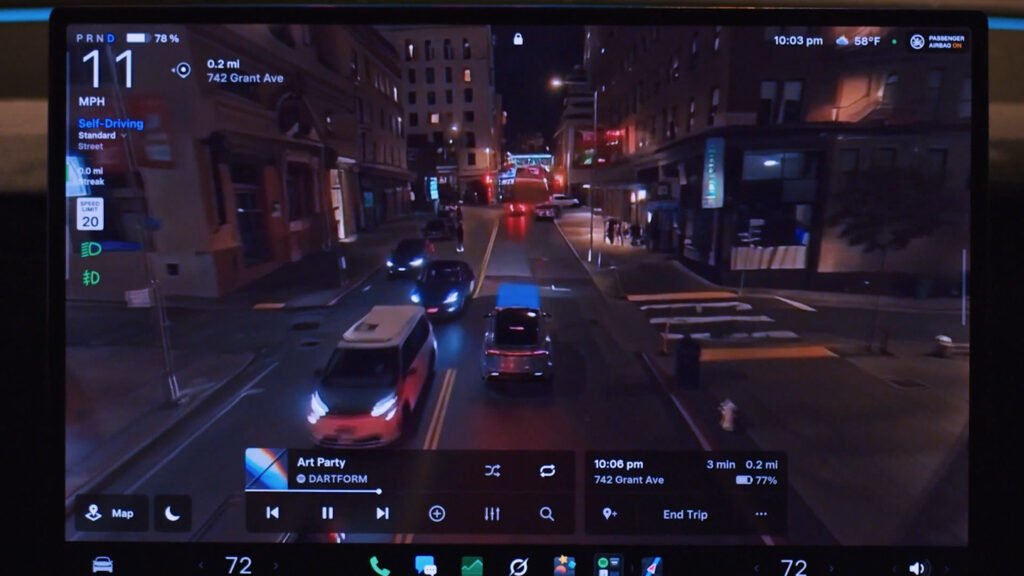
One of the key additions in the latest software is Tesla Reality View, an artificial intelligence-based visualisation feature designed to recreate the vehicle’s surroundings in real time. The technology provides drivers with a visual representation of nearby roads, obstacles and traffic conditions, helping them understand how the system interprets its environment.
The update also introduces an improved vision encoder connected to Tesla’s wider artificial intelligence projects, including its Robotaxi service and Optimus humanoid robot programme. The system is designed to enhance the vehicle’s ability to identify different road situations and respond to changing driving conditions.
Tesla has also introduced several practical improvements aimed at addressing everyday driving challenges. These include better identification of potholes, road signs and standing water, along with automatic speed adjustments near speed cameras. A new Bike Rack Mode has also been included as part of the software improvements.
According to Tesla, the upgraded system offers a substantial improvement in handling safety-critical interventions. However, the company has not released enough independent testing information to establish the precise real-world safety benefits of the claimed improvement.
The latest developments have attracted attention because of the growing competition within the autonomous driving industry. Companies such as Rivian, Ford and General Motors are also working on advanced vehicle technologies that could challenge Tesla’s position.
Rivian is preparing to present its autonomy strategy during its December 9 event, while Ford continues developing its planned Fathom technology for a potential 2027 introduction. General Motors is also working towards offering eyes-off highway driving capabilities on the Cadillac Escalade IQ in 2028.
Another important consideration highlighted by JPMorgan concerns Tesla’s future hardware requirements. Improvements in software efficiency could reduce the immediate need for certain vehicle owners to upgrade to the company’s next-generation AI5 computing hardware. However, the availability of individual features will continue to depend on vehicle specifications and compatibility.
Investor interest has also responded to the latest developments. Tesla shares recorded gains during trading on November 23, although broader movements across technology stocks also contributed to the market’s performance.
Despite the encouraging response, Tesla still faces important challenges before its autonomous driving ambitions can be fully realised. Its Full Self-Driving system currently requires active supervision, meaning drivers must remain attentive and ready to take control whenever necessary. The technology should not be confused with a fully autonomous driving system.
The company’s longer-term strategy extends beyond electric vehicles, with artificial intelligence, robotics and driverless transportation forming important parts of its business plans. Its Robotaxi programme is particularly significant as Tesla attempts to expand its presence in the autonomous transportation market.
The latest software release has provided additional momentum to these ambitions, but sustained progress will depend on technological reliability, regulatory approval, safety performance and public acceptance.
As competition intensifies, Tesla’s ability to translate software improvements into dependable real-world applications will remain an important factor for investors. Wall Street’s latest response indicates continued interest in the company’s autonomous driving plans, while the industry awaits further evidence of how these technologies will perform on public roads.
A mysterious world could be orbiting in the distant outskirts of our solar system, according to new research examining the unusual movements of objects beyond Neptune. Astronomers are investigating whether an undiscovered planet, provisionally referred to as Planet X2, could be responsible for certain orbital patterns that remain difficult to explain using the gravitational influence of the eight recognised planets.
The research offers a new perspective on the possibility of another planetary body existing far beyond the familiar region of the solar system. Based on computer simulations, scientists estimate that the hypothetical planet could have a mass around 1.5 to two times greater than Earth. If confirmed, its discovery could significantly expand current understanding of the solar system’s structure and evolution.
The study, involving planetary scientist Patryk Sofia Lykawka of Kindai University in Japan and researchers from the University of Southern Queensland in Australia, examines how an additional planet might have influenced distant objects over billions of years.
Beyond Neptune is a vast region containing frozen remnants from the early formation of the solar system. Known as the trans-Neptunian region, it includes numerous small icy bodies with different sizes and orbital characteristics. While many follow predictable paths around the Sun, others display unusual movements that have attracted considerable scientific attention.
One example is Sedna, an extremely distant icy object that travels along an unusually stretched orbit. Its orbital behaviour has encouraged researchers to investigate whether an undiscovered planet could be exerting gravitational influence over objects in this remote part of space.
According to the latest simulations, Planet X2 could offer a possible explanation for several of these irregularities. Its gravitational pull may influence the movement of distant icy bodies, potentially explaining why some objects follow highly inclined or elongated orbital paths.
Researchers estimate that the proposed planet could have an average orbital distance of approximately 350 to 500 astronomical units from the Sun. An astronomical unit represents the average distance between Earth and the Sun. Even at its closest approach, the hypothetical planet would remain more than 200 astronomical units away, making direct observation particularly challenging.
The proposed world is also distinct from the frequently discussed Planet Nine hypothesis. Earlier research suggested that a much larger and more distant planet could explain the clustering of certain objects beyond Neptune. Planet X2, however, would be considerably smaller, with a mass closer to that of Earth.
Although the latest findings provide interesting possibilities, scientists have not yet discovered direct evidence confirming the planet’s existence. The theory remains dependent on mathematical models and simulations, meaning further observations are required before any conclusions can be established.
The Vera C. Rubin Observatory in Chile could become an important part of the search. Its advanced telescope is designed to survey large areas of the night sky and identify previously undetected astronomical objects. The observations may help researchers examine distant orbital patterns and determine whether the predicted planet could be present.
The search for additional planets beyond Neptune has been a subject of astronomical investigation for decades. Earlier efforts to understand unusual planetary movements contributed to the discovery of Pluto in 1930, although Pluto was later reclassified as a dwarf planet.
Understanding the distant regions of the solar system could reveal important information about planetary formation, migration and gravitational interactions throughout its history. Finding another planet would also require scientists to reconsider aspects of existing models describing the solar system.
For now, the possibility of Planet X2 remains unconfirmed. Nevertheless, the new research provides astronomers with another direction to explore as increasingly advanced telescopes continue examining the distant boundaries of our cosmic neighbourhood.
UK-based outsourcing firm Capita is dealing with mounting financial and operational difficulties after its shares suffered a dramatic decline of approximately 70%. The market setback follows growing criticism over the company’s handling of the Civil Service Pension Scheme, which has experienced significant administrative problems since Capita took responsibility for its management.
The controversy has also triggered a major change in the company’s leadership. Chief Executive Officer Adolfo Hernandez has agreed to leave his position with immediate effect, as pressure increases over the pension administration failures. Chief Financial Officer Pablo Andres has been appointed as his successor and will oversee the company’s efforts to restore stability and address its current challenges.
Capita assumed responsibility for administering the UK Civil Service Pension Scheme in December 2025. Since then, the service has encountered various difficulties, including delays in processing retirement applications, outstanding pension calculations and interruptions to payments. These problems have affected current and former civil servants who depend on their retirement benefits for financial security.
The scheme serves approximately 1.7 million members, making the disruption a significant concern for pensioners and public sector employees. Delayed payments have reportedly left some retirees struggling to manage essential expenses, including household bills and other everyday costs.
The situation has attracted attention from government officials and parliamentary representatives, with questions raised about the quality of Capita’s services and its ability to resolve the outstanding issues. The company is facing increasing pressure to demonstrate improvements and restore confidence among those affected by the administrative shortcomings.
The leadership transition comes at a particularly difficult time for the outsourcing group. Hernandez’s departure leaves incoming chief executive Pablo Andres responsible for managing the recovery programme while addressing concerns about the company’s financial performance.
Investors have also reacted to the worsening outlook. Capita has warned that its adjusted operating profit for 2027 could be approximately £85 million to £95 million below earlier expectations. The revised forecast reflects the financial impact of addressing the pension administration problems, alongside weaker business conditions and the anticipated loss of extensions to two major contracts.
The company expects to spend an additional £15 million to £25 million in 2027 on measures designed to improve the pension service and resolve existing operational problems. These expenses are adding further pressure to its financial position.
To strengthen its balance sheet, Capita is planning an equity fundraising exercise worth approximately £190 million during the first half of 2027. The proposed move is intended to reduce debt and provide additional financial support as the company works through its difficulties.
Oasis Management Company, Capita’s largest shareholder with an approximately 15.2% stake, has indicated its support for the fundraising proposal and plans to participate at least in proportion to its existing investment.
Meanwhile, the new leadership is expected to prioritise improving pension administration and rebuilding relationships with government clients. Andres will also be responsible for continuing the company’s broader transformation programme while working to restore confidence among investors and customers.
Capita has maintained that its long-term recovery plans remain on track and expects profitability to improve from 2028 onwards. However, achieving that target will depend on its ability to control costs, manage existing contracts and deliver improvements to its services.
The company’s current difficulties highlight the financial and reputational risks associated with large public sector contracts. With millions of pounds at stake and pensioners awaiting improvements, Capita faces considerable pressure to demonstrate that its recovery measures can deliver meaningful results.
The sharp fall in its share price, departure of its chief executive and proposed capital raising have placed the company at a crucial stage. Its progress in resolving the pension scheme problems and stabilising its finances will play an important role in determining its future position in the UK outsourcing industry.
Disney is moving ahead with a major restructuring of its digital entertainment business by bringing Hulu and Disney+ closer together under one streaming platform. The company has confirmed that the integration process is approaching completion, with the combined viewing experience expected to roll out in December 2026.
The decision represents a significant milestone in Disney’s long-term streaming strategy as entertainment companies continue to compete for subscribers in an increasingly crowded market. Through the planned integration, viewers will be able to explore a wider collection of films, television programmes and other entertainment through Disney+, eliminating much of the need to move between separate applications.
Disney outlined its plans in its November 17 quarterly earnings update. Company executives, including Chief Executive Officer Josh D’Amaro and Chief Financial Officer Hugh Johnston, indicated that the upcoming platform will bring together a broader range of entertainment options. The experience is also expected to include live television and selected premium add-ons.
The transition has been developing over several years. Disney began incorporating Hulu programming into Disney+ in 2023, allowing eligible subscribers to discover content from both services through a shared interface. This gradual integration helped establish the foundation for the more comprehensive platform now being developed.
Another important development came in June 2025, when Disney completed its acquisition of Comcast’s remaining interest in Hulu. The agreement gave Disney full ownership of the streaming service and strengthened its ability to determine Hulu’s future direction.
With the latest announcement, the company is taking another step towards consolidating its entertainment offerings.
However, the planned merger has also generated uncertainty surrounding Hulu’s separate application. Despite confirming the unified Disney+ experience, Disney has not announced an official date for discontinuing the standalone Hulu app. Existing Hulu subscriptions also remain available, meaning customers should not assume that their current access will immediately end when the new integration begins.
Eligible subscribers have already been able to connect their Hulu accounts with Disney+, making it possible to access selected programmes without switching platforms. The upcoming changes are expected to expand this arrangement and create a more seamless viewing experience.
Subscription pricing is another issue that could attract attention as the transition progresses. Disney currently provides individual subscriptions and combined packages for customers interested in accessing both services. Although subscription prices have changed over time, the company has not announced a separate price increase specifically linked to the December integration.
The broader objective is to make Disney+ a more comprehensive entertainment destination. By placing different content categories within one application, Disney hopes to improve audience engagement, simplify content discovery and encourage subscribers to maintain their memberships.
The strategy comes at a time when streaming companies are reconsidering how they deliver entertainment. Competition from platforms such as Netflix and Amazon Prime Video has pushed major media businesses to explore bundled subscriptions, expanded libraries and integrated viewing experiences.
Disney is also looking beyond traditional films and television programmes as it explores additional content formats, including live sports, podcasts and vertical video. These developments reflect the company’s ambition to make its streaming platform relevant to a wider audience.
For viewers, the integration could offer greater convenience by bringing more entertainment choices together in one place. Nevertheless, details concerning the future of standalone Hulu subscriptions, individual account arrangements and the eventual retirement of its separate application remain subject to further clarification.
As December approaches, Disney’s planned integration is expected to become one of the most significant developments in its streaming business. While Hulu’s independent application has not yet been given a confirmed shutdown date, its programming is moving towards a closer relationship with Disney+.
The transition could ultimately reshape Disney’s digital entertainment experience and signal a new direction for the wider streaming industry.