North Korean leader Kim Jong Un has reiterated his determination to strengthen the country’s nuclear weapons programme, indicating that Pyongyang will continue expanding its military capabilities despite renewed efforts by US President Donald Trump to restore diplomatic communication.
Kim’s latest comments followed an inspection of several facilities involved in nuclear research and materials production. During the visit, he reportedly called for increased manufacturing capacity and further improvements in the country’s nuclear infrastructure, describing the development of atomic weapons as an essential part of national defence.
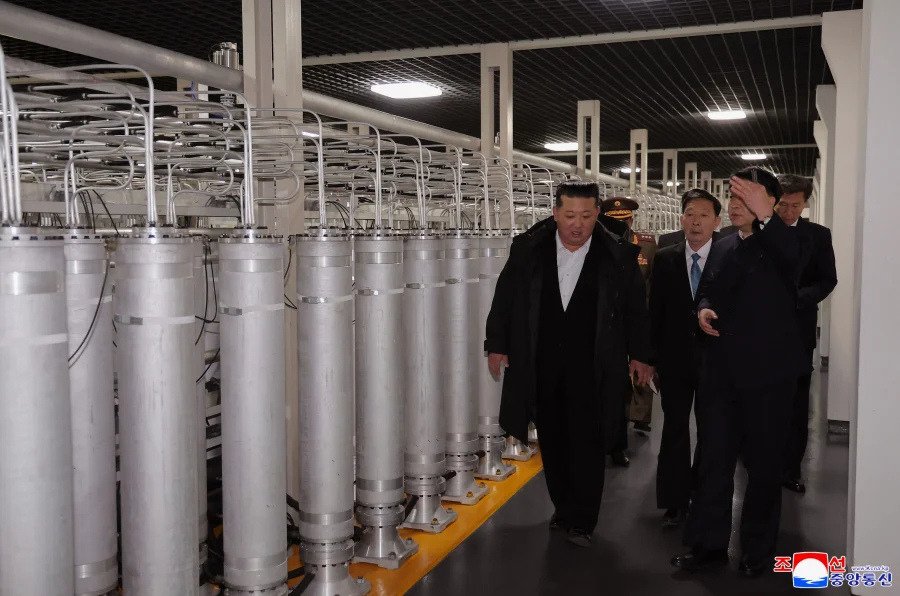
According to the state-run Korean Central News Agency (KCNA), Kim toured two nuclear materials production facilities on Wednesday, November 25. One was described as a newly established factory, while the other was undergoing expansion. He also visited a nuclear research institute and a facility involved in producing nuclear-related equipment.
Images published by North Korean media showed the leader accompanied by senior officials while examining industrial equipment. Rows of machinery resembling uranium-enrichment centrifuges were visible in some photographs, alongside displays of objects that appeared similar to nuclear warheads. However, independent confirmation of the facilities’ precise locations and operational capabilities remains limited.
During the inspection, Kim emphasised that North Korea intended to increase the production of nuclear materials and improve the overall effectiveness of its weapons programme. He maintained that the country’s nuclear status was irreversible and argued that maintaining a strong deterrent was necessary to protect its security interests.
He also highlighted the importance of developing tactical nuclear weapons, which are generally designed for potential use in battlefield situations. Such weapons differ from larger strategic nuclear systems intended primarily to threaten major military or infrastructure targets.
Kim linked the expansion of his country’s arsenal to what he described as growing military pressure from Washington and its regional partners. He criticised the United States for strengthening defence cooperation with South Korea and other allies, arguing that these activities contributed to instability across the Korean Peninsula.
The latest developments come as Trump has expressed interest in reopening discussions with the North Korean leader. During his recent Asian trip, the US president indicated that he remained willing to meet Kim, raising the possibility of renewed diplomatic engagement between the two countries.
However, the proposed encounter did not take place, and North Korea did not publicly respond to the invitation. Trump subsequently suggested that another opportunity for discussions could emerge in the future, including through written communication similar to the exchanges that took place during his first presidential term.
The two leaders previously held several high-profile meetings, including their 2018 summit in Singapore and a subsequent encounter in Hanoi in 2019. Those discussions raised expectations of progress towards reducing North Korea’s nuclear capabilities, but negotiations eventually broke down without a comprehensive agreement.
Since the collapse of those talks, Pyongyang has continued investing in its military infrastructure and expanding its weapons programme. Kim has repeatedly rejected demands that his country surrender its nuclear capabilities, insisting that they are necessary for national security.
International concerns have also increased over developments at North Korea’s nuclear facilities. The International Atomic Energy Agency has raised questions about the country’s expanding uranium-enrichment activities, particularly around the Yongbyon nuclear complex. Such facilities are significant because highly enriched uranium can be used in the production of nuclear weapons.
South Korea continues to monitor Pyongyang’s military activities and maintains close security cooperation with Washington. The developments have added further pressure to regional security discussions, particularly as North Korea continues testing and developing different weapons systems.
For the United States, restarting negotiations remains complicated by the considerable differences between the two governments. Washington continues to support the denuclearisation of the Korean Peninsula, while Pyongyang wants its existing nuclear capabilities recognised as a permanent part of its security arrangements.
Kim’s latest remarks indicate that North Korea intends to prioritise nuclear expansion rather than make immediate concessions in response to American diplomatic overtures. With communication between the two governments still uncertain, efforts to revive negotiations face significant obstacles.
The situation leaves regional governments closely watching Pyongyang’s next steps as concerns surrounding nuclear proliferation and security across East Asia continue.
You can watch the video below