
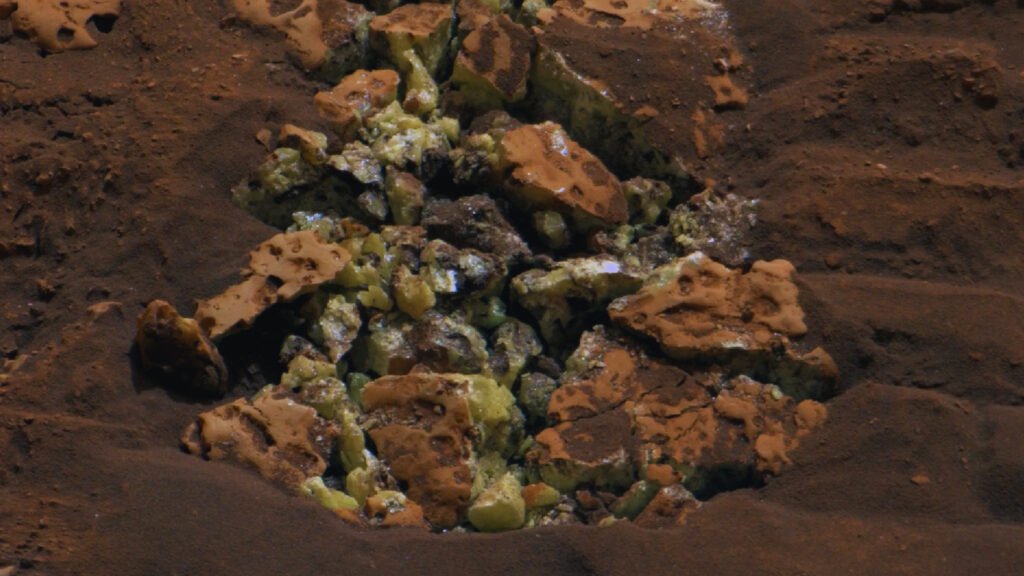
NASA’s Curiosity rover has made an unusual discovery on Mars after accidentally breaking open a rock and exposing bright yellow crystals hidden beneath its surface. The unexpected finding revealed the presence of pure elemental sulfur, marking the first confirmed discovery of this material in its natural form on the Red Planet. Scientists are now investigating how the unusual deposits developed and what they could reveal about Mars’ geological history.
The discovery occurred on May 30, 2024, while Curiosity was exploring Gediz Vallis Channel, a region located within Gale Crater. As the robotic explorer travelled across the rocky landscape, its wheels rolled over a seemingly ordinary stone, causing it to crack open. Images captured by the rover subsequently revealed yellow crystalline material inside the broken rock.
NASA scientists examined the unusual fragments using instruments carried by the rover. Analysis from its Alpha Particle X-ray Spectrometer confirmed that the material consisted of elemental sulfur. The discovery was particularly significant because earlier observations on Mars had identified sulfur-containing minerals, but scientists had never confirmed the presence of pure sulfur on the planet.
The broken rock, nicknamed Convict Lake, became an important target for further investigation. Measuring approximately 13 centimetres across, the exposed fragments provided researchers with an opportunity to examine a material that had previously remained undetected on the Martian surface.
What made the discovery even more surprising was the presence of numerous similar rocks scattered throughout the surrounding landscape. Rather than finding a single unusual specimen, Curiosity encountered an extensive field of bright stones containing pure sulfur. NASA researchers described the discovery as unexpected because the geological conditions required to produce such deposits had not previously been associated with this particular region.
Sulfur is a naturally occurring chemical element found on Earth in several geological environments, including volcanic regions and areas influenced by hydrothermal activity. However, the exact process responsible for producing the Martian deposits remains uncertain. Scientists are examining whether ancient underground chemical reactions, volcanic gases or interactions involving water could have contributed to their formation.
Research published in 2026 has explored possible explanations for the unusual deposits. One proposed mechanism involves sulfur-rich gases originating beneath the Martian surface. These gases may have interacted with water and other chemical compounds, eventually producing elemental sulfur as conditions changed. Laboratory experiments have also demonstrated that certain chemical reactions can produce pure sulfur at relatively low temperatures.
Nevertheless, researchers have not established a definitive explanation for how the deposits formed. Further analysis of the surrounding rocks and geological structures will be necessary to determine which processes were responsible.
You can watch the video below