
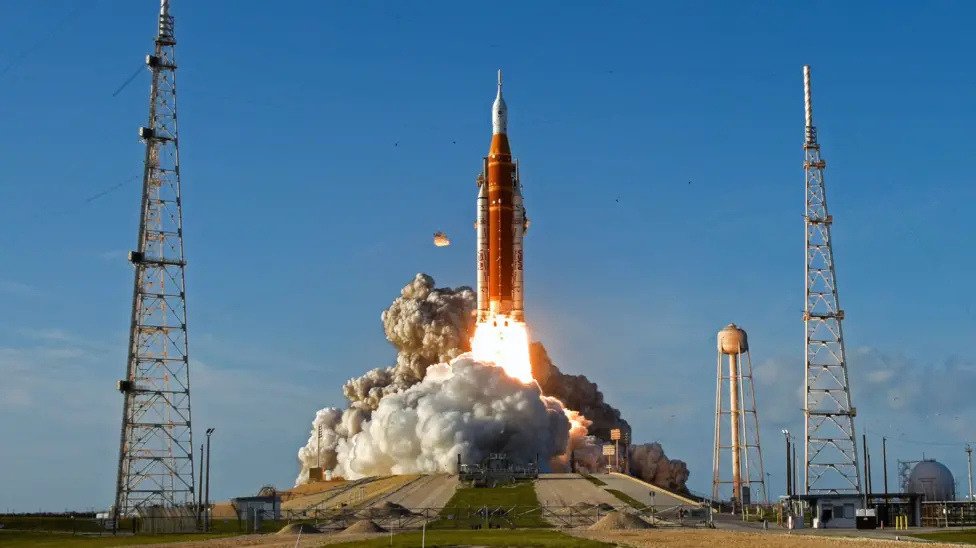
NASA’s Artemis II mission has become the subject of new scientific research after experts identified unusual changes in Earth’s upper atmosphere following the rocket’s launch. The findings suggest that the powerful spacecraft produced disturbances in the ionosphere, potentially influencing the accuracy of satellite navigation signals used by people and industries around the world.
The mission took place on April 1, 2026, sending four astronauts on a historic journey around the Moon. While the flight represented an important achievement in human space exploration, researchers have discovered that the rocket’s powerful engines also produced unexpected effects within Earth’s atmospheric environment.
A research team from National Cheng Kung University in Taiwan examined data collected through a network of advanced GPS receivers distributed across the United States. Their investigation concentrated on the ionosphere, a region of Earth’s upper atmosphere containing electrically charged particles that influence the movement of radio signals transmitted by navigation satellites.
The researchers identified two major areas of atmospheric disturbance associated with the Artemis II launch. Each extended approximately 5,000 kilometres across North America, indicating that the effects were spread over a considerable geographical area.
One disturbance was linked to the movement of the rocket’s central stage through the atmosphere. Another, more pronounced change occurred following engine activity from the upper stage of the Space Launch System (SLS). The researchers associated this disturbance with two engine burns performed at an altitude of approximately 185 kilometres.
These findings are important because the ionosphere plays a significant role in determining the accuracy of GPS positioning. Satellite signals must travel through this atmospheric layer before reaching receivers on the ground. When the concentration of electrons changes, the signals can experience variations in their travel time, potentially affecting location calculations.
According to the researchers, the observed atmospheric changes could translate into temporary positioning inaccuracies of several metres. Although this may appear relatively minor, even small errors could create challenges for technologies that depend on precise location information.
Autonomous vehicles, drones and aviation-related navigation systems are among the technologies that could be affected by such inaccuracies. Charles Lin, a professor at National Cheng Kung University involved in the research, highlighted the potential implications for self-driving vehicles. A positioning error could influence how an autonomous system identifies its location and makes decisions while travelling.
Nevertheless, the findings do not confirm that Artemis II caused widespread GPS outages or actual transportation accidents. Instead, the research identifies atmospheric conditions that could potentially interfere with positioning accuracy. Additional investigations are necessary to establish the extent of any real-world effects.
Scientists also distinguish rocket-generated disturbances from atmospheric interference caused by solar storms. Solar activity can produce significant disruptions to satellite navigation systems, sometimes lasting for extended periods. Changes associated with rocket launches are generally more temporary, although their geographical reach can be considerable.
The discovery comes at a time when space agencies are preparing for increasingly ambitious exploration programmes. With further lunar missions and eventual journeys towards Mars under consideration, understanding the environmental consequences of rocket launches is becoming an important area of research.
Experts believe additional studies will help determine how long these disturbances remain in the atmosphere, which launch activities produce the strongest effects and whether future missions could create similar disruptions.
The research offers a new perspective on the relationship between space exploration and technologies operating on Earth. Although Artemis II represents an important step towards expanding human exploration beyond Earth’s orbit, its atmospheric impact demonstrates that rocket launches can produce effects extending far beyond their immediate flight paths.
As international space programmes continue to develop, scientists will need to examine these interactions more closely to understand their potential implications for satellite navigation and other essential technologies.
You can watch the video below