
The historic Kansas-Missouri football rivalry has returned with renewed intensity, but this time the buildup has generated attention beyond the field. Kansas has leaned into the contentious history surrounding the Border War, using Civil War-era references and slavery-related imagery as part of its promotional campaign for the latest meeting with Missouri.
The Kansas athletic department shared an image of abolitionist John Brown, while athletic director Travis Goff posted material highlighting the Jayhawkers and their role in the anti-slavery movement. The campaign sought to remind fans that the rivalry’s origins extend back to a period when Kansas and Missouri were deeply divided over the future of slavery in the United States.
A promotional video released ahead of the matchup further emphasized that history. The presentation framed the schools as opposing forces and featured references to figures and events associated with the violent conflict along the Kansas-Missouri border. Among those highlighted were Brown, an abolitionist who became one of the most recognizable figures connected to the struggle, and William Quantrill, a Confederate guerrilla leader.
The historical roots of the Border War date to the 1850s, when the question of whether Kansas would enter the Union as a free or slave state produced intense conflict. Armed groups supporting opposing causes crossed the border, leading to violence that became known as “Bleeding Kansas.”
Several notorious episodes emerged from that period. The Sack of Lawrence in 1856 saw the anti-slavery town attacked by pro-slavery forces, while the Pottawatomie Massacre involved the killing of five pro-slavery settlers by men associated with Brown. Those events became part of the complicated history later attached to the Kansas-Missouri sporting rivalry.
Even the schools’ nicknames have connections to the era. Kansas became known as the Jayhawks, a name associated with anti-slavery fighters in the territory, while Missouri adopted the Tigers in connection with a local militia that defended Columbia during the border conflicts.
The football series itself dates back to 1891 and has developed into one of college football’s longest-running rivalries. However, the contest disappeared from the regular schedule when Missouri left the Big 12 for the Southeastern Conference after the 2011 season.
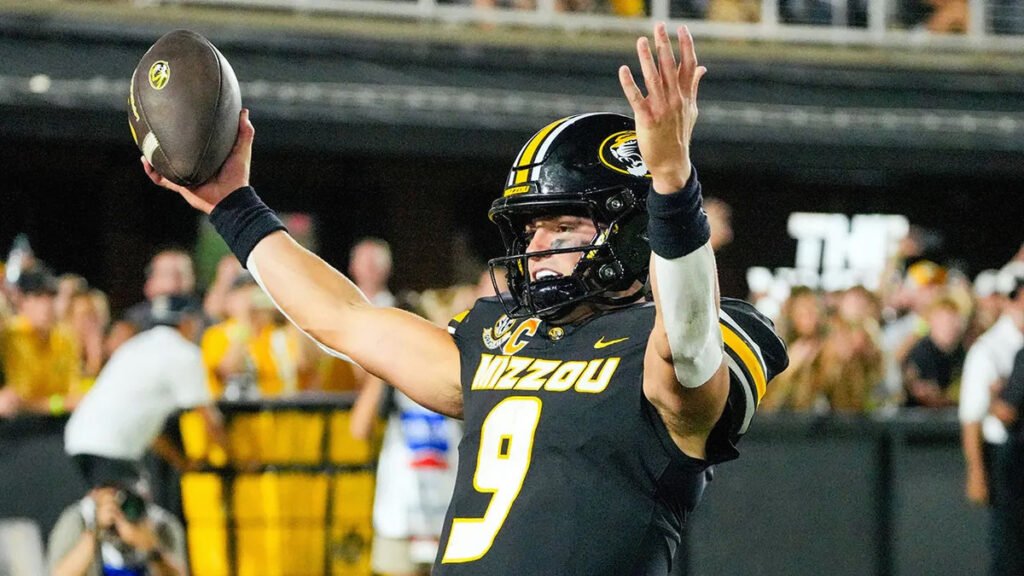
The Border War eventually returned in 2025 after a 14-year interruption. Missouri won that contest 42-31, giving the Tigers bragging rights in the first renewal of the rivalry in more than a decade.
The latest meeting in Lawrence has therefore provided Kansas with an opportunity to answer that defeat while reigniting the emotions surrounding the historic series. Missouri entered the game ranked No. 23 nationally after a strong opening-week performance, while Kansas was also looking to continue its momentum following an impressive start to the season.
Kansas’ decision to invoke the rivalry’s historical roots has produced differing reactions. Supporters argue that the campaign accurately reflects what makes the Border War different from a conventional college football rivalry. Critics, however, have questioned the decision to use slavery, Civil War violence and controversial historical figures to generate excitement for a sporting event.
The debate also centers on how that history should be presented. Some observers have argued that reducing complex events involving slavery, political conflict and violence to a straightforward “heroes versus villains” narrative risks oversimplifying the past.
For the universities, however, the modern Border War remains primarily a football contest between neighboring programs. The players taking the field decades after those historical conflicts are competing for a victory, while the references to the past are being used to add atmosphere and meaning to the occasion.
The renewed rivalry demonstrates how deeply history remains connected to Kansas and Missouri football. Unlike many college matchups built primarily around geography or decades of competition, the Border War has roots in one of the most divisive periods in American history.
With Kansas embracing that legacy in its promotional campaign and Missouri seeking to maintain its recent advantage, the latest meeting has once again placed one of college football’s oldest rivalries in the national spotlight.