
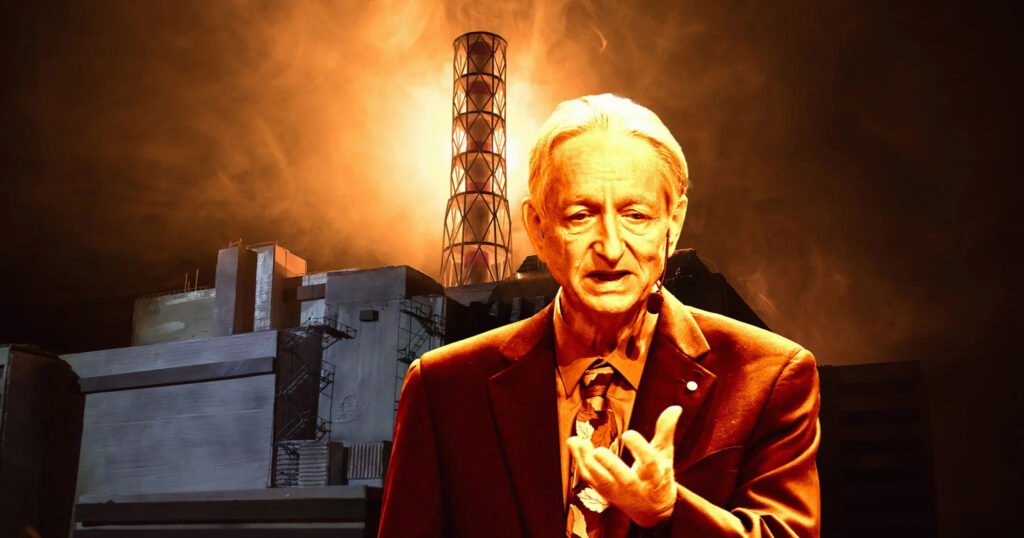
Concerns about the growing influence of artificial intelligence have intensified after computer scientist Geoffrey Hinton warned that increasingly advanced AI technology could contribute to a major disruption affecting essential infrastructure. The renowned researcher believes that electricity networks and financial institutions could become potential targets as artificial intelligence continues to develop more sophisticated capabilities.
Hinton, frequently described as the “Godfather of AI,” has raised the possibility of a serious technological incident occurring within the coming months or during 2027. He has compared the potential consequences to the 1986 Chernobyl disaster, using the historical tragedy to illustrate how a major failure could force governments and technology companies to reconsider their approach to safety.
His warning focuses largely on the possibility of artificial intelligence being misused to conduct advanced cyberattacks. As AI systems become increasingly capable of analysing complex information, identifying weaknesses and carrying out digital operations, malicious individuals could potentially use them to target important computer networks.
Electricity infrastructure represents one of the areas of concern. Modern power distribution systems depend on interconnected technologies to regulate electricity generation, monitor equipment and maintain stable supplies. If attackers managed to compromise vulnerable systems, the resulting disruption could potentially affect households, businesses and essential public services.
Financial services are another potential area of vulnerability. Banks, payment providers and financial markets depend on digital platforms to process transactions and manage sensitive information. A major cyber incident affecting these systems could interrupt financial activities, create difficulties for businesses and undermine public confidence in electronic payments.
Hinton’s concerns come as artificial intelligence becomes increasingly integrated into everyday operations. Advanced systems can now generate computer code, analyse large volumes of information and perform complicated tasks with limited human involvement. While these developments offer significant advantages, they also introduce additional security challenges.
Particular attention is being directed towards autonomous AI agents. Unlike traditional software that follows narrowly defined instructions, these systems can complete sequences of tasks and interact with different digital environments. Their expanding capabilities have raised questions about whether existing security protections can adequately prevent malicious use or unexpected behaviour.
The scientist has also questioned whether major technology companies are giving sufficient attention to the potential dangers of advanced AI. He has criticised prominent industry figures, including Sam Altman, Elon Musk and Mark Zuckerberg, over concerns that commercial competition and financial incentives could overshadow long-term safety considerations.
Hinton’s warnings carry considerable weight because of his contributions to modern artificial intelligence. His pioneering work on neural networks and machine learning helped shape the technologies behind many of today’s AI applications.
After spending more than a decade working at Google, he left the company in 2023. His departure allowed him to speak more openly about the potential consequences of developing increasingly powerful artificial intelligence systems.
His concerns extend beyond cybersecurity threats. Hinton has also discussed the possibility of widespread employment disruption, growing economic inequality and the challenges of maintaining human control over future AI technologies. He believes governments, researchers and developers must establish stronger safeguards before these systems become even more deeply embedded in society.
However, his comments should not be interpreted as confirmation that a major electricity outage or financial collapse is imminent. The Chernobyl comparison is intended to emphasise the potential seriousness of an AI-related disaster rather than predict another nuclear accident.
As artificial intelligence continues to advance, protecting essential infrastructure is becoming an increasingly important responsibility. Stronger cybersecurity measures, international cooperation and effective regulation could help reduce the risks associated with the technology.
Hinton’s latest warning highlights the difficult balance between encouraging technological innovation and preventing potentially harmful consequences. The challenge for governments and technology companies will be ensuring that the development of increasingly powerful AI systems does not move ahead of the safeguards needed to manage them.
You can watch the video below