
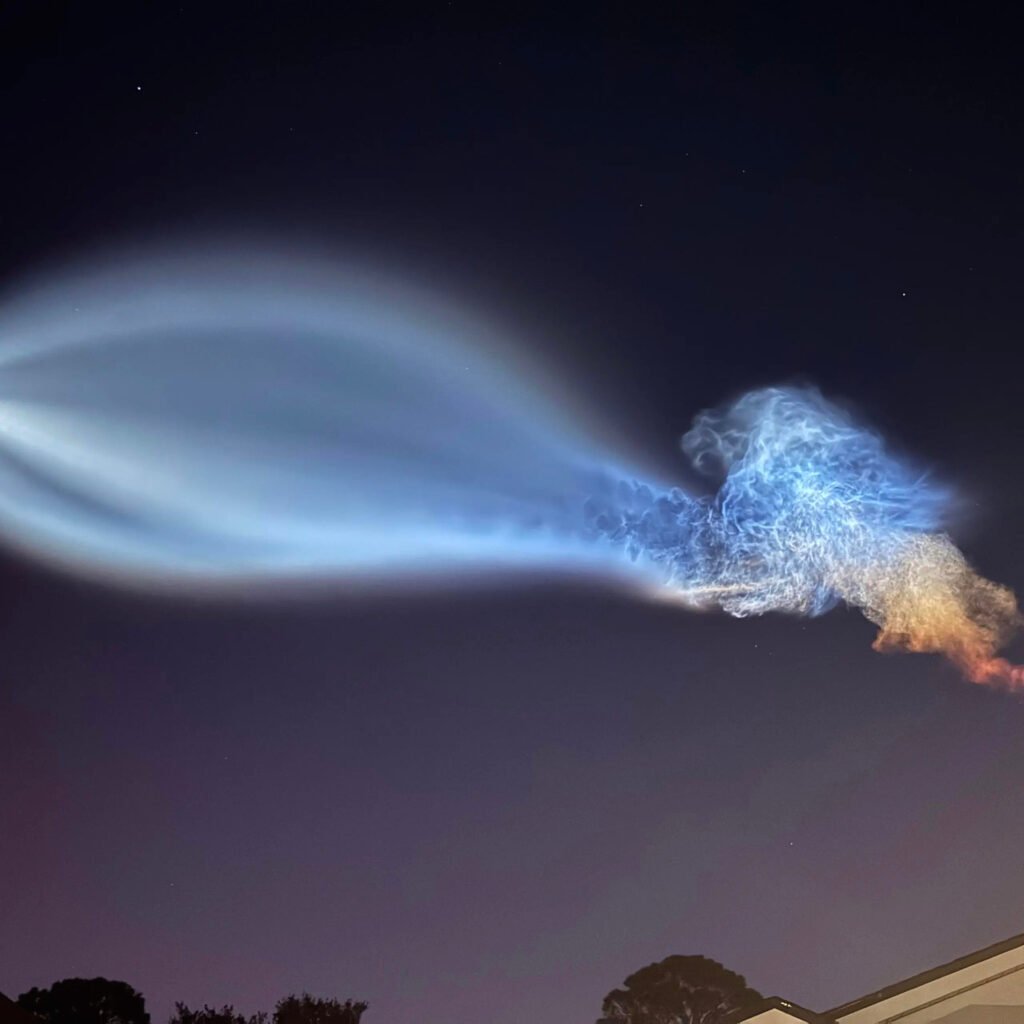
Skywatchers in Central Florida may have an opportunity to witness an unusual spectacle in the early-morning sky as SpaceX prepares for another Falcon 9 rocket launch. Under the right atmospheric conditions, the rocket could produce a luminous formation commonly called a “space jellyfish,” creating the appearance of a glowing body surrounded by long, trailing strands.
The phenomenon occurs when sunlight illuminates a rocket’s exhaust plume at high altitude while the ground below remains relatively dark. The contrast can produce a striking display that resembles a giant jellyfish floating across the sky. Although the effect is not guaranteed during every launch, it has become a familiar sight for observers near Florida’s busy spaceports.
SpaceX’s Bandwagon-5 mission is scheduled to launch from Cape Canaveral, Florida, with a target time of 6:30 a.m. Eastern Time on Tuesday, October 20. The mission was moved from its earlier Monday opportunity because of unfavorable weather conditions affecting the recovery operation. A further launch opportunity is available Wednesday if conditions prevent liftoff on Tuesday.
The flight forms part of SpaceX’s rideshare programme, which enables multiple customers to send satellites and other payloads into orbit aboard a single rocket. By sharing launch costs, the programme offers a more accessible option for organisations seeking to deploy smaller spacecraft.
While delivering these payloads into orbit is the mission’s main purpose, the rocket’s ascent could also attract attention from people watching the sky. If the launch takes place at a suitable time and the rocket reaches the right altitude, its expanding exhaust plume may become visible as a bright, jellyfish-shaped formation.
A similar spectacle followed a SpaceX Falcon 9 launch from Cape Canaveral on October 13. That mission transported NASA’s CRS-35 Dragon cargo spacecraft toward the International Space Station, and its illuminated exhaust plume was seen across several parts of the eastern United States.
The science behind the display is relatively straightforward. During launches around dawn or dusk, the atmosphere near the ground can remain dark while the rocket climbs into sunlight. The exhaust gases released at altitude scatter and expand, creating a broad plume that reflects sunlight against the darker sky.
As the plume spreads, its changing shape can produce a bright central section with delicate extensions resembling tentacles. Depending on the altitude, atmospheric conditions and viewing angle, the formation may appear white, bluish or orange. These variations give each display a distinctive appearance.
However, seeing the phenomenon depends on several factors. Cloud cover, local weather, the rocket’s trajectory and the precise timing of the launch can all influence visibility. Even if the rocket is visible, the exhaust plume may not develop into a clearly defined jellyfish shape.
People hoping to catch the event should look for official launch updates before making plans. Because launch schedules can change at short notice, the announced time should be treated as a target rather than a guarantee. Observers should also choose a location with a relatively unobstructed view of the sky.
The mission is also expected to include an attempted landing of the Falcon 9’s first-stage booster on the Atlantic Ocean droneship A Shortfall of Gravitas. Recovering and reusing rocket boosters is a central part of SpaceX’s launch strategy, helping the company reduce costs and increase the frequency of its missions.
Beyond its operational objectives, the launch demonstrates how commercial spaceflight can create memorable public viewing opportunities. A routine rocket ascent can briefly transform the predawn sky into a striking natural-looking spectacle, combining modern engineering with the effects of sunlight and atmospheric conditions.
For Central Florida residents, the possibility of a glowing space jellyfish offers another reason to watch the skies. Whether the formation appears as a bright plume or a more subtle trail, the launch could provide a memorable glimpse of space technology in action. Nevertheless, the final appearance will depend on the conditions at liftoff, making the spectacle a possibility rather than a certainty.
You can watch the video below