
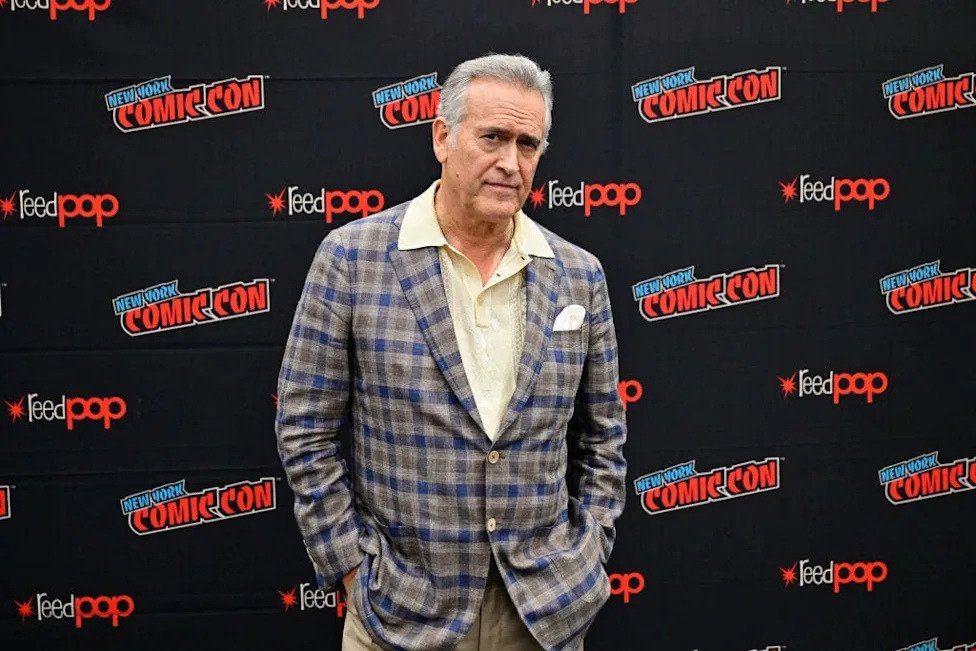
Bruce Campbell is speaking openly about the reality of living with cancer after revealing that doctors have given him a prognosis of approximately five years. The Evil Dead star, however, says he is determined not to allow the diagnosis to become a countdown or overshadow the life he still wants to lead.
Campbell discussed his health during a recent appearance on The Adam Carolla Show, where he was asked about the cancer diagnosis he first made public earlier this year. According to Campbell, his current prognosis has been described as a “five-year deal.” When host Adam Carolla clarified whether that meant he had roughly five years to live, Campbell responded, “Give or take.”
The latest disclosure provides a clearer picture of Campbell’s situation than his initial announcement in March. At that time, the actor revealed that he had been diagnosed with a form of cancer that was treatable but not curable. He did not publicly identify the specific type of cancer and said he did not intend to provide extensive medical details.
Campbell also indicated that his illness has affected him mentally as much as, or perhaps more than, physically. Speaking about the experience, he described cancer as something that can create a series of complications requiring constant attention. Rather than becoming consumed by researching the disease or focusing on worst-case scenarios, he said he has chosen to approach his circumstances differently.
“I’ve decided pretty specifically though to live with it, not die from it,” Campbell said during the podcast appearance.
That outlook has become a central part of the actor’s approach to his diagnosis. Campbell has acknowledged that receiving a serious prognosis can change a person’s perspective, but he does not want cancer to determine how he spends his remaining time.
Earlier in the year, Campbell had already begun scaling back some professional commitments so he could concentrate on treatment. His decision affected appearances and fan conventions, areas that have played an important role in his relationship with audiences throughout his career.
Despite those changes, the actor has continued working on creative projects. He is currently promoting Ernie & Emma, a film he wrote, directed, produced and stars in. The project is also taking him on an 18-city screening tour, giving him an opportunity to remain professionally active while sharing the movie with audiences.
Campbell’s career has made him particularly familiar to horror and genre fans. He became widely recognized for playing Ash Williams in Sam Raimi’s The Evil Dead, a role he later reprised in Evil Dead II, Army of Darkness and the television series Ash vs. Evil Dead. He has also appeared in projects outside the franchise, including the television series Burn Notice and Raimi’s Spider-Man films.
His latest comments have generated renewed attention because they reveal the seriousness of his current prognosis, but Campbell has continued to emphasize the importance of living in the present rather than constantly thinking about the future.
He has also spoken about gaining a stronger appreciation for everyday life since receiving his diagnosis. In a conversation with TheWrap, Campbell described a newfound sense of appreciation and gratitude, suggesting that the experience has changed the way he looks at the present.
Campbell’s five-year estimate should not be interpreted as a precise prediction of his lifespan. The actor has not publicly disclosed the specific cancer involved, its stage or the medical factors behind the prognosis. His comments represent the outlook he says has been given to him by his doctors.
For now, Campbell appears focused on continuing his treatment while maintaining his work and personal priorities. Rather than allowing the diagnosis to define his identity, he has chosen to keep moving forward and make use of the opportunities available to him.
His latest message reflects a combination of realism and determination. While acknowledging the uncertainty surrounding his future, Campbell is making clear that he intends to spend that future living rather than simply waiting for the disease to determine what happens next.