
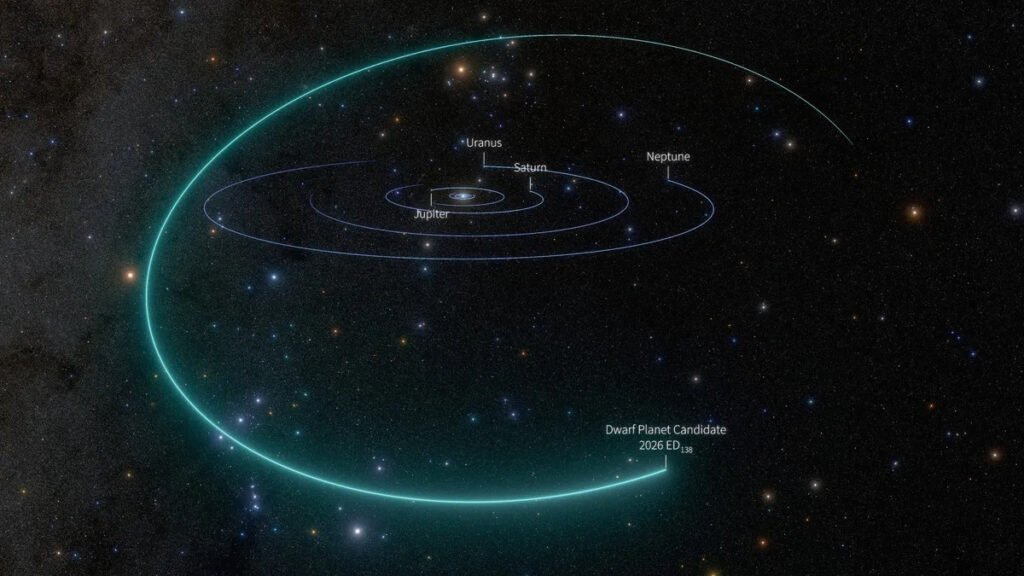
A mysterious celestial body located in the distant outer regions of the solar system has attracted the attention of astronomers, with researchers investigating whether it could qualify as a new dwarf planet. The object, provisionally identified as 2026 ED138, was detected through observations made by the NSF–DOE Vera C. Rubin Observatory in Chile.
Early estimates indicate that the icy object could measure between 600 and 1,500 kilometers across. Its considerable size and unusual orbital characteristics have made it an interesting discovery for scientists studying the region beyond Neptune.
The object was identified by astrophysicist Matthew Holman while examining astronomical images collected by the Rubin Observatory. On October 13, 2026, Holman noticed an unusual moving point of light among observations of distant stars. Further analysis suggested that it was a previously unidentified object travelling through the outer solar system.
Researchers subsequently examined additional telescope records to establish its movement and determine whether it was a genuine celestial body. Earlier observations dating back to 2016 were also identified, allowing astronomers to reconstruct part of its orbital journey.
One of the most unusual aspects of 2026 ED138 is its position and movement around the Sun. Preliminary calculations place it approximately 46 astronomical units away from our star. This means that it is around 46 times farther from the Sun than Earth.
Its orbital path is also tilted by approximately 25 degrees compared with the main plane in which most planets travel. Scientists believe that gravitational interactions involving Neptune could have influenced its unusual trajectory.
The discovery has generated interest because relatively little is known about the population of icy objects occupying the outermost parts of the solar system. Studying these distant bodies could provide valuable information about how the planetary system developed billions of years ago.
Currently, the International Astronomical Union officially recognizes five dwarf planets: Pluto, Ceres, Eris, Haumea and Makemake. If the newly identified object satisfies the necessary scientific conditions, it could potentially become the sixth officially recognized member of this category.
However, astronomers have not yet confirmed its classification. A celestial body must meet specific requirements before receiving dwarf planet status. It must orbit the Sun, possess sufficient gravitational strength to maintain an approximately spherical shape and must not have cleared other objects from its orbital neighborhood.
Although the estimated dimensions of 2026 ED138 make it a promising candidate, further investigation is necessary. Scientists need more accurate measurements of its diameter, surface composition and physical properties before determining whether it qualifies.
Additional observations using advanced infrared instruments could help resolve some of these uncertainties. Researchers may also use powerful space telescopes to investigate the object’s surface and determine its characteristics more precisely.
The finding highlights the growing importance of the Vera C. Rubin Observatory in astronomical research. Situated on Cerro Pachón in Chile, the facility is designed to repeatedly photograph large portions of the sky and identify objects that move or change over time.
Its planned decade-long Legacy Survey of Space and Time is expected to uncover thousands of previously undetected celestial objects. Scientists anticipate that some of these discoveries could include additional dwarf planet candidates hidden in the distant reaches of the solar system.
The discovery of 2026 ED138 offers another opportunity to investigate the mysterious region beyond Neptune. By studying its orbit and physical structure, astronomers hope to gain a clearer understanding of the icy bodies that occupy the outer solar system.
Although the object has not yet received official dwarf planet recognition, its discovery represents an important step in expanding scientific knowledge of our planetary neighborhood. Further observations will determine whether this distant world eventually joins Pluto and the other recognized dwarf planets.
You can watch the video below