
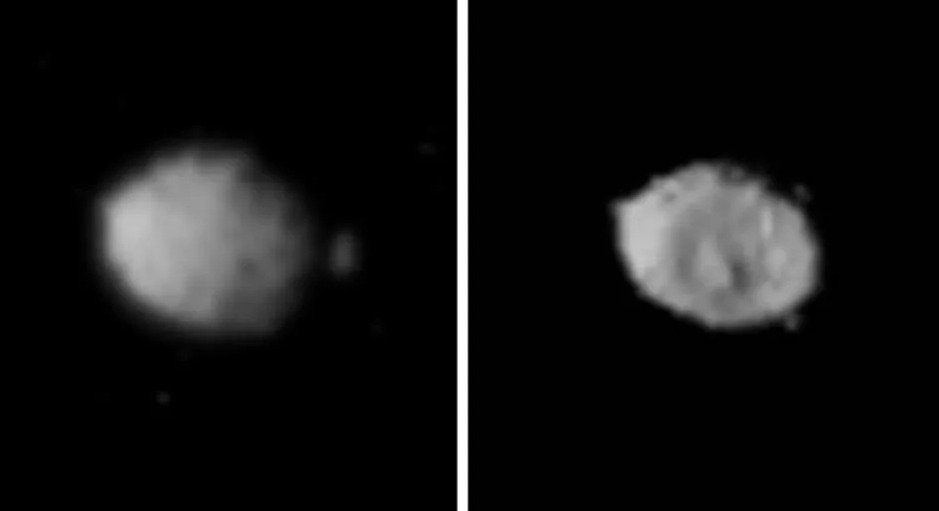
Fresh images of an asteroid have uncovered the remarkable impact of a planetary defence experiment carried out by NASA, revealing a huge crater covering almost the entire width of the space rock. The observations are giving scientists a better understanding of how asteroids respond to high-speed collisions and whether similar technology could eventually help protect Earth from potentially dangerous objects approaching the planet.
The photographs were obtained by the European Space Agency’s Hera spacecraft, which is examining the aftermath of NASA’s Double Asteroid Redirection Test (DART). The experiment involved deliberately crashing a spacecraft into Dimorphos, a small asteroid orbiting the larger space rock Didymos, to determine whether such an impact could alter an asteroid’s movement.
The historic collision took place on September 26, 2022, when NASA directed its DART spacecraft towards Dimorphos at considerable speed. The mission was designed to demonstrate whether a carefully planned spacecraft impact could change the trajectory of an asteroid, offering a possible method of preventing future collisions with Earth.
Recent observations have revealed the considerable damage caused by the spacecraft. The resulting crater extends across almost the entire surface width of Dimorphos, which measures approximately 151 metres in diameter. The discovery has attracted scientific attention because the scale of the impact demonstrates how much an asteroid’s structure can be affected by a relatively small spacecraft travelling at high speed.
Researchers have also identified changes in the asteroid’s physical behaviour following the collision. Dimorphos is now rotating in an unstable and irregular pattern, indicating that the impact affected more than its surface. The findings suggest that the spacecraft collision altered the asteroid’s rotation and physical structure.
Another significant observation involves hundreds of boulders found around the Didymos asteroid system. Scientists believe these rocks were displaced during the collision, with material being thrown away from Dimorphos and scattered into the surrounding space. Researchers are studying their positions and movements to understand how the asteroid reacted to the force of the impact.
The experiment also produced a measurable change in Dimorphos’s orbit around Didymos. Following the collision, its orbital period became approximately 33 minutes shorter. This demonstrated that a spacecraft could successfully influence the movement of an asteroid through a controlled collision.
The European Space Agency launched its Hera spacecraft to investigate the long-term consequences of the experiment and provide detailed information about the resulting damage. The mission is designed to examine the asteroid’s surface, internal composition and physical characteristics, helping scientists understand why the collision produced such significant changes.
Hera carries specialised scientific equipment, including cameras and instruments capable of studying the asteroid’s environment. These tools will allow researchers to gather information that could not be obtained during NASA’s initial impact mission.
The spacecraft is also expected to release two smaller CubeSats, named Juventas and Milani, to conduct additional investigations. Juventas will use radar technology to examine Dimorphos’s internal structure, while Milani will study its surface materials and surrounding dust. Their observations are expected to provide further information about the asteroid’s composition and the effects of the collision.
Scientists consider this research important because asteroids vary considerably in size, density and internal structure. Some are solid objects, while others consist of loosely connected collections of rocks and dust. Understanding these differences is essential when calculating how much force would be necessary to redirect an asteroid travelling towards Earth.
Despite the enormous crater and the changes caused by the experiment, neither Dimorphos nor Didymos poses a danger to Earth. The system was specifically selected for the mission because the experiment could be conducted without creating a threat to the planet.
The findings represent an important achievement in international planetary defence research. NASA’s DART mission demonstrated that an asteroid’s orbital movement could be changed through a deliberate collision, while ESA’s Hera mission is helping scientists understand the physical consequences in greater detail.
As further observations continue, researchers hope to develop more accurate methods of predicting how asteroids respond to spacecraft impacts. The knowledge gained could become valuable in preparing for future threats from space and developing technologies capable of protecting Earth from potentially hazardous asteroids.
You can watch the video below