Tesla is drawing fresh interest from financial analysts and investors as the electric vehicle manufacturer continues advancing its autonomous driving technology. The company’s latest Full Self-Driving (FSD) software update has attracted favourable attention from Wall Street, reinforcing expectations about its potential role in the future of artificial intelligence-powered transportation.
The company has started introducing FSD version 15, which includes several changes intended to improve vehicle awareness, road navigation and the interpretation of surrounding environments. The release represents another step in Tesla’s broader efforts to strengthen its position in the autonomous mobility industry.
JPMorgan analyst Rajat Gupta has expressed a positive assessment of Tesla’s progress, highlighting the company’s developments in consumer-focused autonomous driving. His comments come as other automotive manufacturers increase investments in artificial intelligence and advanced driver-assistance systems to compete in the expanding market.
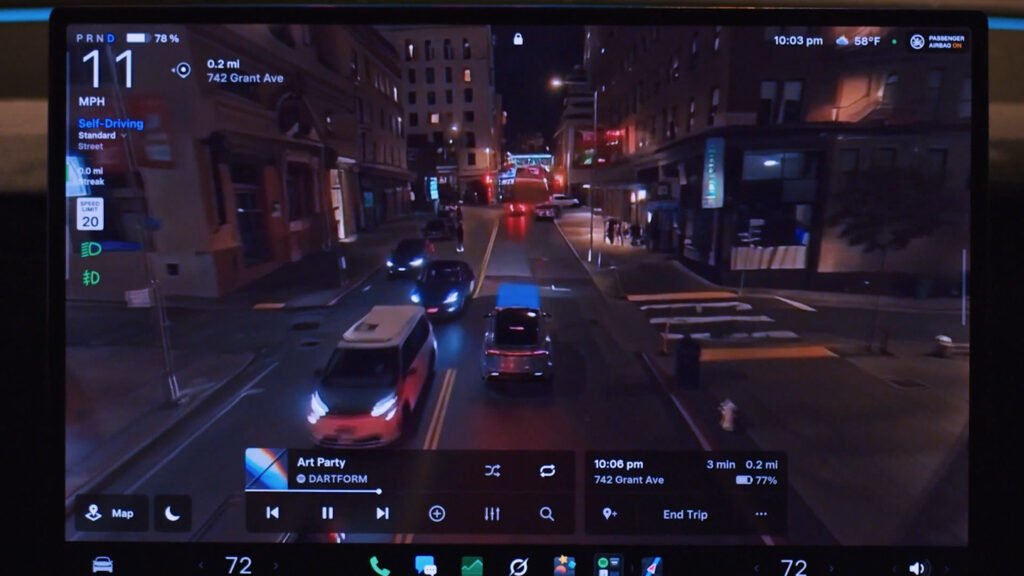
One of the key additions in the latest software is Tesla Reality View, an artificial intelligence-based visualisation feature designed to recreate the vehicle’s surroundings in real time. The technology provides drivers with a visual representation of nearby roads, obstacles and traffic conditions, helping them understand how the system interprets its environment.
The update also introduces an improved vision encoder connected to Tesla’s wider artificial intelligence projects, including its Robotaxi service and Optimus humanoid robot programme. The system is designed to enhance the vehicle’s ability to identify different road situations and respond to changing driving conditions.
Tesla has also introduced several practical improvements aimed at addressing everyday driving challenges. These include better identification of potholes, road signs and standing water, along with automatic speed adjustments near speed cameras. A new Bike Rack Mode has also been included as part of the software improvements.
According to Tesla, the upgraded system offers a substantial improvement in handling safety-critical interventions. However, the company has not released enough independent testing information to establish the precise real-world safety benefits of the claimed improvement.
The latest developments have attracted attention because of the growing competition within the autonomous driving industry. Companies such as Rivian, Ford and General Motors are also working on advanced vehicle technologies that could challenge Tesla’s position.
Rivian is preparing to present its autonomy strategy during its December 9 event, while Ford continues developing its planned Fathom technology for a potential 2027 introduction. General Motors is also working towards offering eyes-off highway driving capabilities on the Cadillac Escalade IQ in 2028.
Another important consideration highlighted by JPMorgan concerns Tesla’s future hardware requirements. Improvements in software efficiency could reduce the immediate need for certain vehicle owners to upgrade to the company’s next-generation AI5 computing hardware. However, the availability of individual features will continue to depend on vehicle specifications and compatibility.
Investor interest has also responded to the latest developments. Tesla shares recorded gains during trading on November 23, although broader movements across technology stocks also contributed to the market’s performance.
Despite the encouraging response, Tesla still faces important challenges before its autonomous driving ambitions can be fully realised. Its Full Self-Driving system currently requires active supervision, meaning drivers must remain attentive and ready to take control whenever necessary. The technology should not be confused with a fully autonomous driving system.
The company’s longer-term strategy extends beyond electric vehicles, with artificial intelligence, robotics and driverless transportation forming important parts of its business plans. Its Robotaxi programme is particularly significant as Tesla attempts to expand its presence in the autonomous transportation market.
The latest software release has provided additional momentum to these ambitions, but sustained progress will depend on technological reliability, regulatory approval, safety performance and public acceptance.
As competition intensifies, Tesla’s ability to translate software improvements into dependable real-world applications will remain an important factor for investors. Wall Street’s latest response indicates continued interest in the company’s autonomous driving plans, while the industry awaits further evidence of how these technologies will perform on public roads.
You can watch the video below