
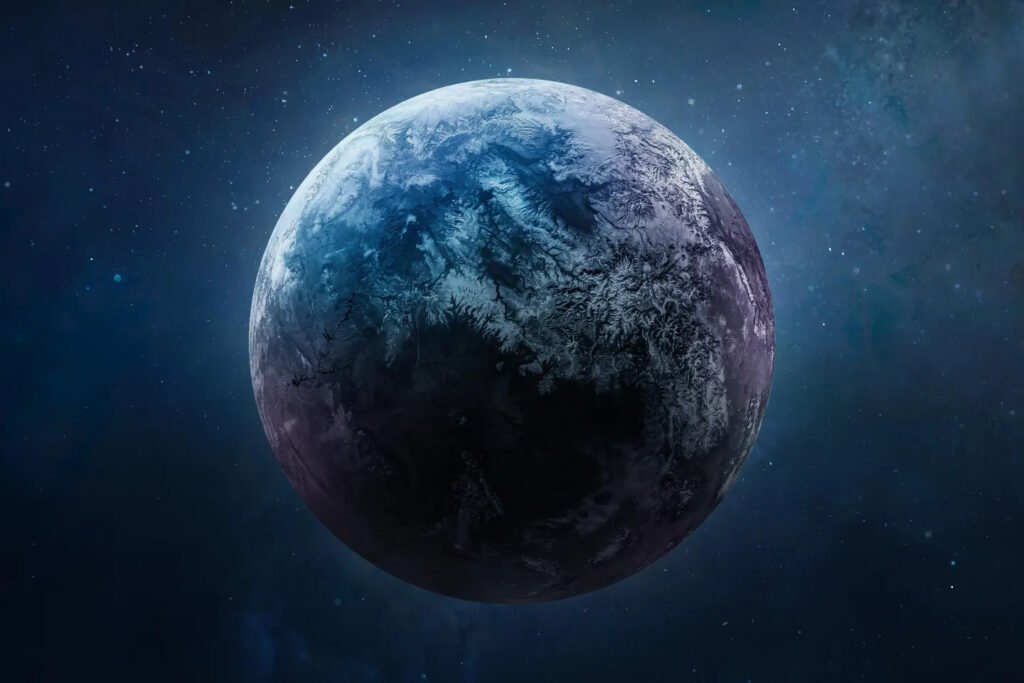
A mysterious world could be orbiting in the distant outskirts of our solar system, according to new research examining the unusual movements of objects beyond Neptune. Astronomers are investigating whether an undiscovered planet, provisionally referred to as Planet X2, could be responsible for certain orbital patterns that remain difficult to explain using the gravitational influence of the eight recognised planets.
The research offers a new perspective on the possibility of another planetary body existing far beyond the familiar region of the solar system. Based on computer simulations, scientists estimate that the hypothetical planet could have a mass around 1.5 to two times greater than Earth. If confirmed, its discovery could significantly expand current understanding of the solar system’s structure and evolution.
The study, involving planetary scientist Patryk Sofia Lykawka of Kindai University in Japan and researchers from the University of Southern Queensland in Australia, examines how an additional planet might have influenced distant objects over billions of years.
Beyond Neptune is a vast region containing frozen remnants from the early formation of the solar system. Known as the trans-Neptunian region, it includes numerous small icy bodies with different sizes and orbital characteristics. While many follow predictable paths around the Sun, others display unusual movements that have attracted considerable scientific attention.
One example is Sedna, an extremely distant icy object that travels along an unusually stretched orbit. Its orbital behaviour has encouraged researchers to investigate whether an undiscovered planet could be exerting gravitational influence over objects in this remote part of space.
According to the latest simulations, Planet X2 could offer a possible explanation for several of these irregularities. Its gravitational pull may influence the movement of distant icy bodies, potentially explaining why some objects follow highly inclined or elongated orbital paths.
Researchers estimate that the proposed planet could have an average orbital distance of approximately 350 to 500 astronomical units from the Sun. An astronomical unit represents the average distance between Earth and the Sun. Even at its closest approach, the hypothetical planet would remain more than 200 astronomical units away, making direct observation particularly challenging.
The proposed world is also distinct from the frequently discussed Planet Nine hypothesis. Earlier research suggested that a much larger and more distant planet could explain the clustering of certain objects beyond Neptune. Planet X2, however, would be considerably smaller, with a mass closer to that of Earth.
Although the latest findings provide interesting possibilities, scientists have not yet discovered direct evidence confirming the planet’s existence. The theory remains dependent on mathematical models and simulations, meaning further observations are required before any conclusions can be established.
The Vera C. Rubin Observatory in Chile could become an important part of the search. Its advanced telescope is designed to survey large areas of the night sky and identify previously undetected astronomical objects. The observations may help researchers examine distant orbital patterns and determine whether the predicted planet could be present.
The search for additional planets beyond Neptune has been a subject of astronomical investigation for decades. Earlier efforts to understand unusual planetary movements contributed to the discovery of Pluto in 1930, although Pluto was later reclassified as a dwarf planet.
Understanding the distant regions of the solar system could reveal important information about planetary formation, migration and gravitational interactions throughout its history. Finding another planet would also require scientists to reconsider aspects of existing models describing the solar system.
For now, the possibility of Planet X2 remains unconfirmed. Nevertheless, the new research provides astronomers with another direction to explore as increasingly advanced telescopes continue examining the distant boundaries of our cosmic neighbourhood.
You can watch the video below