US Director of National Intelligence Jay Clayton has come to the defence of President Donald Trump following criticism over his decision to refer to Russian President Vladimir Putin as his “friend”. Clayton argued that the choice of words was appropriate in the context of diplomatic engagement, although he acknowledged that significant disagreements remain between Washington and Moscow, particularly over the war in Ukraine.
During television interviews on Sunday, November 22, 2026, Clayton discussed the president’s approach to international relations following a high-profile gathering involving the United States, Russia and China. He described the meeting as an important diplomatic occasion, highlighting the significance of communication between three countries with considerable influence over global security and nuclear affairs.
Appearing on ABC’s This Week, Clayton was asked whether Trump’s description of Putin as a friend was appropriate. He defended the president’s wording, suggesting that maintaining constructive personal relationships with international leaders could help create opportunities for diplomatic discussions.
Clayton also expressed confidence in Trump’s ability to manage sensitive foreign policy matters. He indicated that the president’s choice of language should be understood within the broader context of his efforts to maintain communication with other world leaders.
Nevertheless, the intelligence chief clarified that a personal diplomatic relationship should not be confused with America’s position on Russia’s military actions. Addressing the situation in Ukraine, he made it clear that Putin could not be regarded as a friend of the United States in relation to the ongoing conflict.
The discussion followed Trump’s meeting with Putin and Chinese President Xi Jinping in Shenzhen, China, on November 19. The gathering attracted international attention because of the strategic importance of the three nations and their influence on global political and security matters.
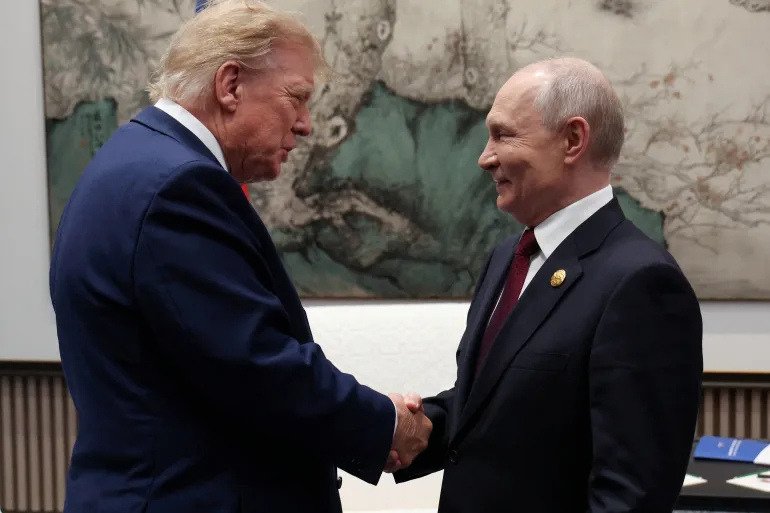
Following the meeting, Trump shared a photograph of himself shaking hands with the Russian president on his Truth Social platform. He accompanied the image with the caption “My Friend”, prompting criticism from several American politicians and international observers.
Trump subsequently defended his remarks, arguing that maintaining a positive relationship with a leader who controls a major nuclear power was preferable to creating unnecessary hostility. He suggested that diplomatic communication was essential, particularly when dealing with countries capable of influencing international stability.
However, his comments generated disagreement among members of the Democratic Party. Senate Democratic leader Chuck Schumer criticised the president’s participation in the gathering, describing the summit as an embarrassment for the United States. He questioned whether Trump’s approach had delivered meaningful diplomatic advantages.
European representatives have also expressed reservations about the president’s friendly portrayal of Putin. Polish Prime Minister Donald Tusk rejected the suggestion that the Russian leader could be considered a friend, reflecting continuing concerns among European governments about Moscow’s actions against Ukraine.
Russia launched its full-scale invasion of Ukraine in February 2022. Since then, the conflict has caused widespread destruction, displacement and casualties, while creating significant diplomatic tensions between Russia and Western nations. The United States and several European countries have imposed sanctions on Moscow and provided military and financial assistance to Kyiv.
The continuing war remains a major challenge for international diplomacy, with disagreements over security guarantees, territorial issues and potential negotiations complicating efforts to achieve a lasting settlement.
Clayton’s defence of Trump’s comments highlights the administration’s preference for maintaining direct communication with influential world leaders, even when their governments have conflicting interests. His remarks also demonstrate the distinction between diplomatic engagement and political agreement.
As discussions surrounding the summit continue, Trump’s relationship with Putin is likely to remain a subject of political debate. Supporters of the president’s approach view personal diplomacy as a possible way to reduce tensions, while critics argue that friendly language towards the Russian leader risks sending the wrong message amid the continuing conflict in Ukraine.
You can watch the video below