
The bipartisan agreement that reshaped Social Security in 1983 remains an important example of how Washington addressed a major financial challenge through negotiation and legislative compromise. As concerns about the program’s long-term funding resurface, the historic reform offers insight into the difficult choices facing lawmakers as they seek to protect benefits for current and future generations.
More than four decades ago, Social Security faced a serious financial emergency that threatened its ability to pay scheduled benefits in full. The program’s financial difficulties placed considerable pressure on Congress and the administration of President Ronald Reagan to develop a solution before the shortfall became an immediate payment crisis.
Efforts to resolve the problem began with the creation of the National Commission on Social Security Reform in 1981. Led by economist Alan Greenspan, the commission brought together representatives from different political backgrounds to examine the program’s finances and recommend changes. After months of discussions, a majority of its members reached an agreement in January 1983, providing a framework for congressional action.
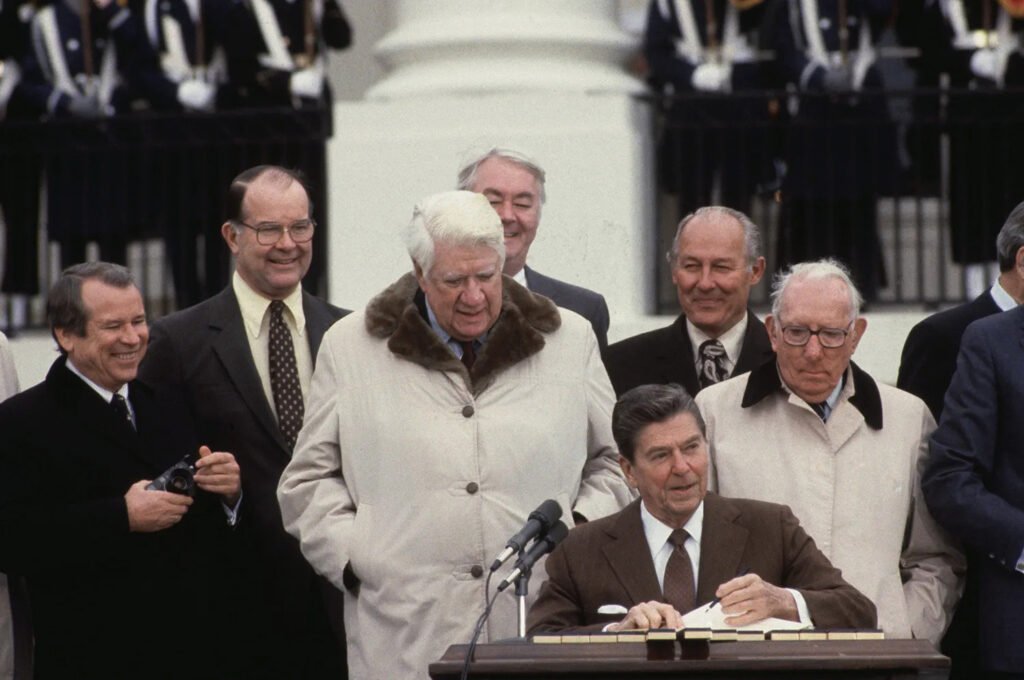
Congress approved the Social Security Amendments of 1983, which Reagan signed into law on April 20 of that year. Rather than depending on a single measure, the legislation introduced a combination of tax adjustments, benefit changes and other provisions designed to improve the system’s financial position.
One of the most consequential changes involved gradually raising the full retirement age from 65 to 67. The increase was phased in over time, with the later retirement age applying to younger generations. The legislation also accelerated previously scheduled increases in payroll taxes and established federal taxation on part of the benefits received by certain higher-income beneficiaries.
Additional provisions expanded Social Security coverage to newly hired federal employees and certain nonprofit workers. Together, these measures were intended to increase revenue while adjusting the program’s obligations over the longer term.
The legislation helped resolve the immediate funding emergency and strengthened Social Security’s financial outlook. However, it did not permanently eliminate the gap between the program’s projected income and its future obligations. Changes in population patterns, life expectancy and economic conditions have since renewed questions about the system’s long-term sustainability.
Those concerns have once again placed Social Security among Washington’s major policy challenges. The program supports millions of Americans through retirement payments, disability benefits and assistance for eligible family members and survivors. Any substantial changes could therefore affect households across different age groups and income levels.
Lawmakers and policy analysts have considered a range of possible approaches to improving the program’s finances. Options include increasing payroll tax revenue, modifying benefit formulas, adjusting retirement rules or combining several measures. Proposals to raise taxes on higher-income earners have also featured prominently in the debate.
Each approach carries potential consequences, and disagreements remain over how financial responsibilities should be shared. Some policymakers emphasize protecting benefits, while others focus on closing projected funding gaps through revenue increases, spending adjustments or a combination of both.
The experience of 1983 illustrates why negotiations may be essential when addressing a challenge of this scale. The agreement required participants to accept provisions that did not fully match their individual preferences. Its passage demonstrated that cooperation between the White House and congressional leaders could produce legislation even when significant political differences remained.
Another lesson is the importance of acting before financial pressures become an immediate emergency. Early negotiations can give lawmakers more time to examine alternatives, assess their consequences and consider how proposed changes would affect different generations.
However, the conditions surrounding the current debate are not identical to those of the early 1980s. Demographic developments, economic circumstances and today’s political environment create distinct challenges that any new legislation would need to address.
Ultimately, Social Security’s future depends on decisions about how to maintain reliable benefits while ensuring that the program can meet its financial obligations. The 1983 reforms provide a historical example of bipartisan action, but today’s lawmakers must determine which combination of policies is appropriate for the challenges facing the system now.
you can watch the video below