
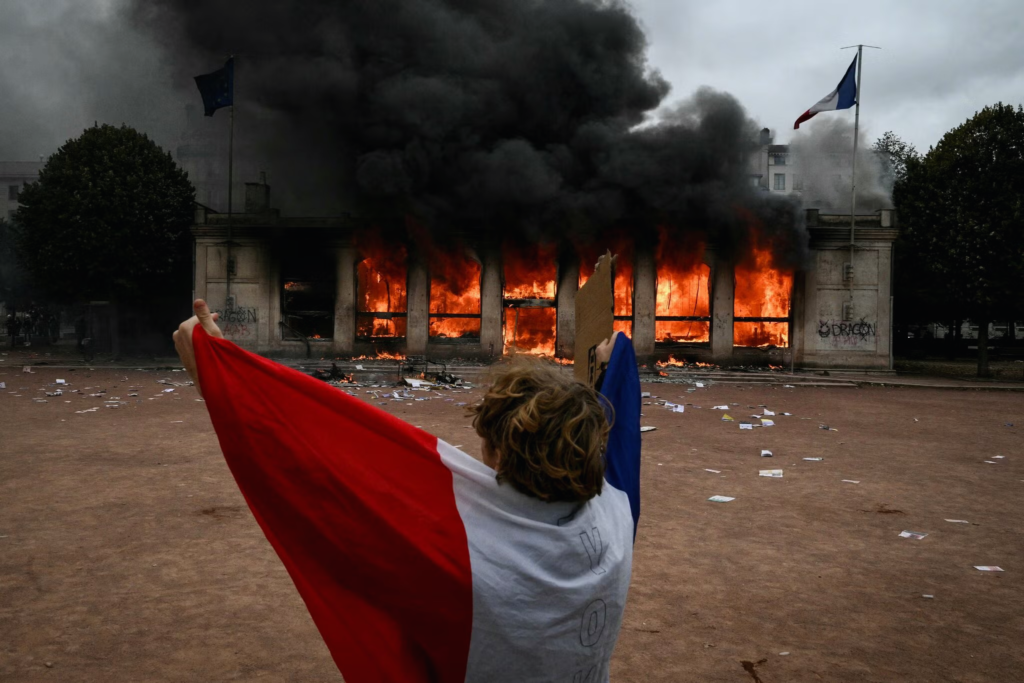
France experienced widespread protests on October 17, 2026, as students, workers and trade union members gathered in cities across the country to demand better living conditions, improved education services and stronger economic support. Although many demonstrations began peacefully, clashes between protesters and police, along with incidents of vandalism and arson, disrupted several locations and prompted a major security response.
The movement, initially driven by student concerns, expanded into a broader expression of public dissatisfaction over rising household expenses and the quality of public services. The demonstrations highlighted mounting frustration among people struggling with the cost of food, energy, transport and other essential goods.
France’s Interior Ministry estimated that approximately 550,000 people participated in 110 demonstrations nationwide. Trade union representatives, including the CGT, placed attendance at around 800,000, reflecting the significant mobilisation behind the protests. Participants included secondary school students, university students, teachers, employees and members of wider social movements.
Economic pressure was among the principal concerns raised by demonstrators. Many called for higher wages, better pensions and measures to protect purchasing power as household budgets continued to face pressure. Protesters also demanded greater investment in education and public services, arguing that students and lower-income families needed more substantial support.
The student movement had gained momentum in the weeks leading up to the national demonstrations. School blockades and rallies drew attention to educational conditions and the challenges facing young people. As the campaign expanded, trade unions and other groups joined the protests, linking education-related demands with broader concerns about economic inequality.
Paris witnessed some of the most serious disturbances during the demonstrations. Police used tear gas and water cannons after groups of masked individuals reportedly threw objects and fireworks at officers near Place de la République. Fires broke out, vehicles were damaged and several businesses were targeted by looters. Authorities also restricted access to some metro stations around areas affected by the unrest.
Other cities experienced incidents of violence and property damage. In Lyon, a fire broke out inside a tourist office, while businesses and public facilities were damaged in Marseille. Groups of demonstrators entered the lobby of Marseille’s city hall, and a municipal police station was also targeted. Limoges reported a fire at its city hall, while disturbances were recorded in Bordeaux, Lille and other urban centres.
Police operations intensified as authorities attempted to contain the violence and protect public buildings. Hundreds of people were initially reported arrested, with the total later reaching approximately 1,200, according to Prime Minister Sébastien Lecornu. Around 150 police officers and gendarmes were reported injured during the unrest.
President Emmanuel Macron condemned attacks on public institutions and destruction of property, stressing that those responsible should be held accountable. Government officials maintained that peaceful demonstrations were legitimate but that violence and criminal damage could not be justified. Police continued operations in areas where disturbances had been reported.
The demonstrations have added to political pressure on the French government as the country approaches the 2027 presidential election. Rising living costs, dissatisfaction with public services and concerns about economic fairness have become important subjects in the national debate.
For students and workers taking part, the protests offered an opportunity to call for better wages, more accessible education and greater financial security. However, the violent incidents overshadowed many of these demands and raised questions about how authorities should respond to large-scale demonstrations.
The government now faces the challenge of addressing public grievances while restoring confidence in public institutions and maintaining order. Protesters, meanwhile, continue to seek meaningful action on living costs, educational conditions and the funding of essential services.
The events of October 17 illustrate how student-led demonstrations can develop into a nationwide movement when they connect with broader economic concerns. Whether the protests result in policy changes remains uncertain, but the scale of participation has placed public spending, purchasing power and education firmly at the Centre of France’s political debate.
You can watch the video below