
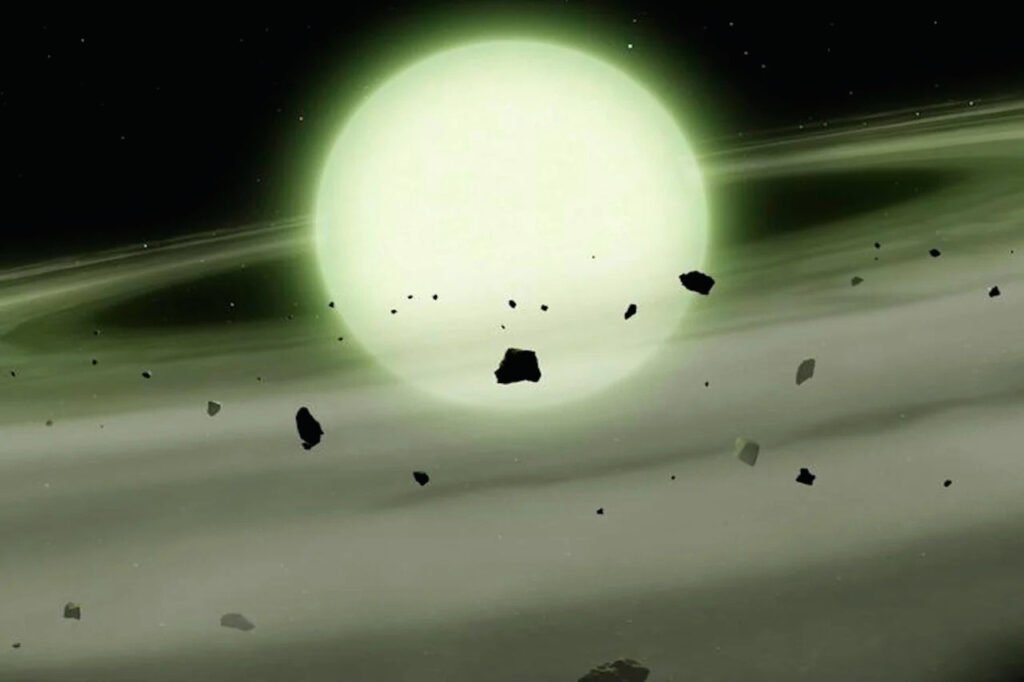
A rare stellar object with an unusual greenish appearance has attracted the attention of astronomers, offering new insights into what happens to planetary systems when their central stars reach the end of their lives. Identified as WD J1330+6435, the object is a white dwarf located approximately 280 light-years from Earth in the constellation Draco.
Researchers believe its distinctive colour is associated with the chemical elements present in its atmosphere, including material absorbed from the rocky remnants of its former planetary system. The discovery provides an opportunity to investigate how stars change after their active lifetimes end and how planetary debris can influence their appearance.
The research, conducted by scientists at the University of Warwick in England, was reported in October 2026. The findings, published in the scientific journal RAS Techniques and Instruments, highlight the relationship between atmospheric chemistry and the light emitted by stellar remnants.
White dwarfs form when stars similar to the Sun exhaust their nuclear fuel and release their outer layers into space. What remains is an extremely dense stellar core that gradually cools over time. Although these objects are generally associated with white or pale colours, their chemical compositions can produce unexpected visual characteristics.
WD J1330+6435 stands out because its atmosphere contains elements such as sodium, calcium and lithium. Their presence suggests that rocky debris from its former planetary system has fallen onto the stellar remnant. Astronomers refer to this process as accretion, which can reveal clues about planetary material that survived the transformation of its central star.
The unusual colour is believed to result largely from the behaviour of sodium under the extreme conditions inside the white dwarf’s atmosphere. Sodium typically absorbs light within a relatively narrow range of wavelengths. However, interactions with surrounding helium atoms under intense atmospheric pressure can broaden these absorption features.
Consequently, more light from the orange and red portions of the visible spectrum is absorbed. This changes the balance of colours reaching an observer and gives the stellar object its unusual yellowish-green appearance.
Scientists reached this conclusion by examining the star’s spectrum and applying models that account for human colour perception. The greenish hue is therefore a scientific interpretation based on measurements rather than a simple visual observation through an ordinary telescope.
The discovery was part of a broader investigation into the appearance of white dwarfs. Researchers examined 151 nearby stellar remnants to understand how temperature and atmospheric chemistry influence their colours. Another object, WD J1011+2845, attracted attention because its carbon-rich atmosphere gives it a salmon-pink appearance.
These findings suggest that white dwarfs can display a wider range of colours than traditionally expected. Depending on their chemical composition and physical conditions, some may appear greenish, pink, purple or other unusual shades.
Beyond their appearance, these stellar remnants could help scientists understand the final stages of planetary systems. When a star evolves into a white dwarf, changes in its gravitational environment can disturb the orbits of remaining planets, asteroids and other bodies. Some of this material may eventually move close enough to be torn apart or drawn onto the stellar remnant.
By analysing the chemical elements deposited in a white dwarf’s atmosphere, astronomers can investigate the composition of planetary material that once existed around the star. This method offers an indirect way to study distant worlds that may no longer survive as intact planets.
Further observations could establish how common these unusually coloured stellar remnants are. Researchers may also refine their atmospheric models to better understand the physical processes responsible for their appearance and identify additional examples through astronomical surveys.
The discovery of WD J1330+6435 demonstrates that even the remnants of long-dead stars can reveal unexpected characteristics. Its greenish colour is not evidence of a conventional green star, but rather a result of complex atmospheric chemistry and the possible absorption of planetary debris.
By examining such objects, scientists can gain a better understanding of stellar evolution, the destruction of planetary systems and the material left behind when stars reach the final stages of their lives.
You can watch the video below