
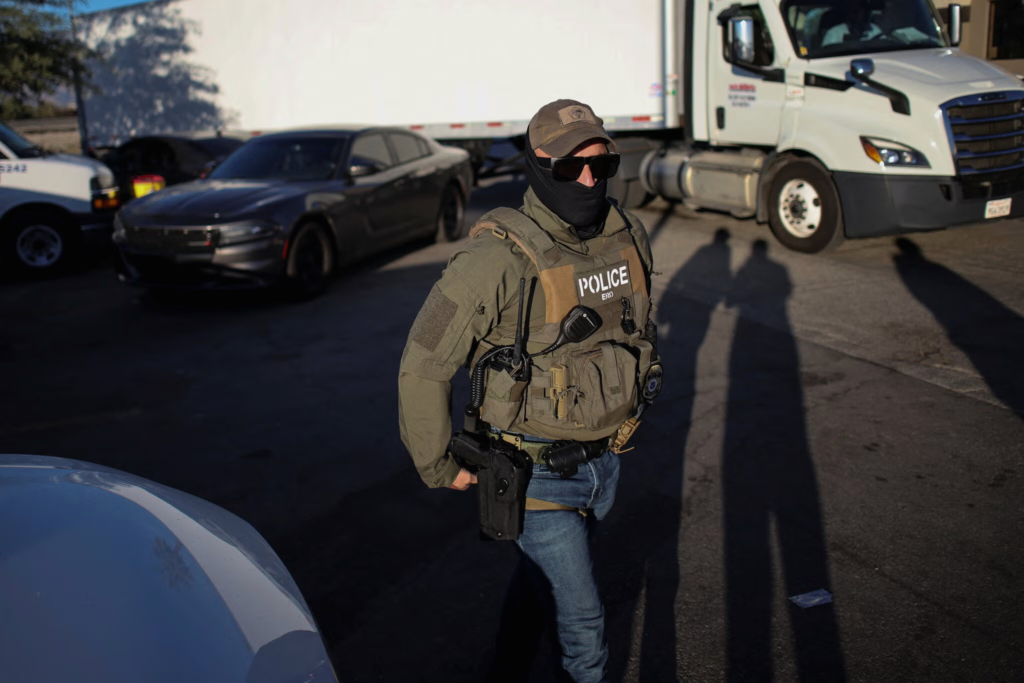
A federal appeals court has dealt a setback to California’s efforts to require visible identification for federal law enforcement officers, blocking enforcement of a state provision that sought to make it easier for the public to identify personnel carrying out official duties. The decision highlights an ongoing legal dispute over the balance between state authority, federal powers and accountability in immigration enforcement.
The case centres on California’s No Vigilantes Act, which established identification requirements for certain law enforcement officers operating within the state. Supporters of the legislation argued that visible identification could help members of the public distinguish legitimate officers from individuals falsely claiming law enforcement authority. Federal officials, however, challenged the measure, arguing that California lacked the constitutional power to impose such requirements on federal personnel performing their official responsibilities.
The Ninth Circuit Court of Appeals sided with the federal government in the dispute, finding that the identification provision raised serious constitutional concerns. The ruling prevents California from enforcing the challenged requirement against federal agencies and officers while the legal proceedings continue.
The decision represents an important development in the broader disagreement between California and the federal government over immigration enforcement practices and the limits of state regulation.
California enacted the No Vigilantes Act in 2025 amid growing concerns about federal immigration operations and the identification of officers involved in enforcement activities. The legislation required certain non-uniformed law enforcement officers to display identifying information, including their agency and either their name or badge number, subject to specified exceptions.
State officials defended the measure as a way to strengthen transparency and public confidence. They argued that people encountering officers during arrests or immigration operations should have a reasonable opportunity to determine which agency the officers represent.
The federal government disputed that position, maintaining that states cannot independently establish rules governing the conduct of federal employees carrying out duties authorised by national law. Officials warned that state-level requirements could interfere with federal operations and create conflicting standards for agencies working across different jurisdictions.
The legal battle consequently raised questions about the constitutional relationship between federal and state governments. At the centre of the dispute was the Supremacy Clause, which establishes that valid federal law takes precedence over conflicting state requirements.
The appeals court determined that California’s identification mandate likely conflicted with these constitutional principles because it directly attempted to regulate federal officers performing their official duties without congressional authorisation. The court’s conclusion strengthened the federal government’s argument that the state had exceeded its authority in adopting the challenged provision.
The litigation had already produced earlier developments. A lower court initially allowed the identification requirement to remain in effect while restricting a separate provision concerning masks. The appeals court subsequently issued temporary relief against enforcement of the identification rule before considering the dispute further.
The latest decision directs the lower court to enter an injunction preventing California officials, including Governor Gavin Newsom and Attorney General Rob Bonta, from enforcing the challenged provision against federal agencies and officers.
The ruling does not settle every issue involving federal immigration enforcement or establish that all identification requirements for officers are unlawful. Instead, it addresses the specific question of whether California can impose this requirement on federal personnel under the circumstances presented in the case.
For California, the outcome represents a setback in its attempt to introduce stronger transparency measures for federal law enforcement activities. State officials have argued that visible identification can help the public understand who is exercising law enforcement authority and provide greater clarity during encounters with officers.
The federal government, meanwhile, maintains that national agencies must be able to perform their responsibilities without facing conflicting state regulations. The dispute reflects broader tensions over immigration policy, public oversight and the constitutional limits of government authority.
The ruling could also influence discussions in other states considering similar legislation governing law enforcement identification. Any such measures may face legal scrutiny if they attempt to regulate federal personnel directly.
Ultimately, the appeals court’s decision reinforces the importance of constitutional boundaries between state and federal powers. While California sought to improve public accountability through identification requirements, the court concluded that the challenged provision could not be enforced against federal officers.
The case remains significant for the continuing debate over transparency in immigration enforcement and the extent to which states can influence the operations of federal agencies. Its outcome may shape future legislative efforts and legal challenges involving the conduct of federal officers across the United States.
You can watch the video below