
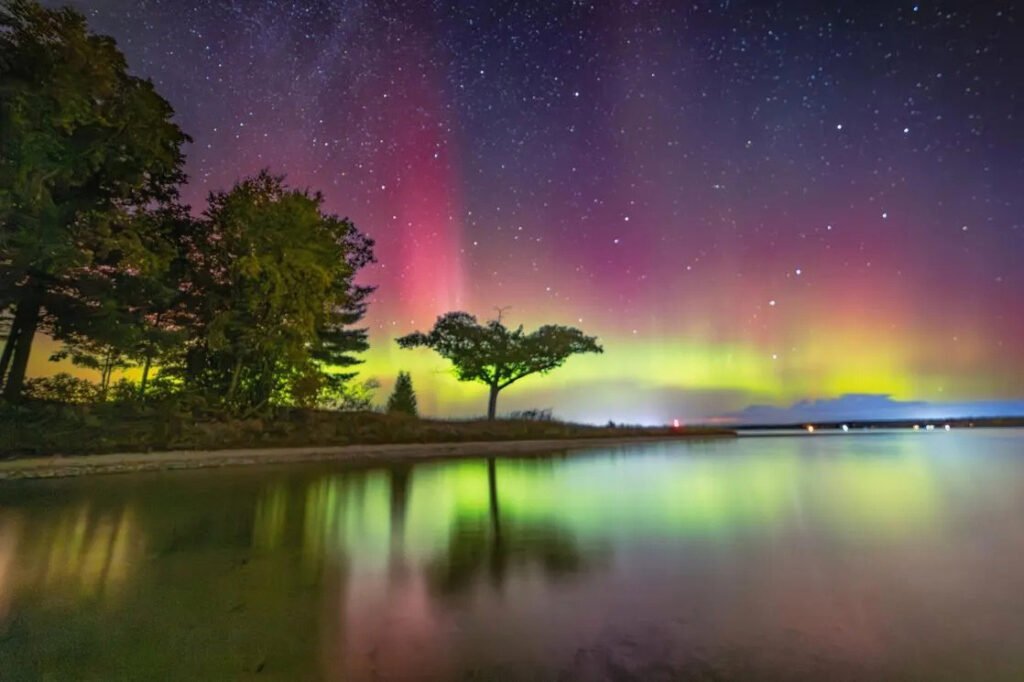
Skywatchers in parts of the United States could be treated to a rare nighttime spectacle Thursday and early Friday, with the northern lights potentially becoming visible across a broad stretch of the country.
The possible display is being driven by increased solar activity and the arrival of a coronal mass ejection, commonly known as a CME. This large release of charged particles and magnetic energy from the Sun can interact with Earth’s magnetic field and produce a geomagnetic storm, potentially pushing the aurora farther south than usual.
Forecasts suggest that the strongest chances of seeing the aurora will remain across the northern United States. Alaska is expected to have some of the best opportunities, while areas close to the Canadian border could also experience favorable conditions.
Potential viewing areas include Washington, Idaho, Montana, North Dakota, South Dakota, Minnesota, Wisconsin, Michigan, Maine, Vermont and New Hampshire. If geomagnetic activity becomes stronger, the aurora could potentially reach farther south into Oregon, Wyoming, Nebraska, Iowa, Illinois, Indiana, Ohio, Colorado, Pennsylvania and New York.
That does not mean residents throughout all 22 states will definitely see the lights. Aurora visibility depends on several conditions, including the strength of the geomagnetic storm, the timing of the disturbance, local weather and the amount of artificial light in the area.
Clouds could be one of the biggest obstacles for skywatchers. Even strong auroral activity may remain hidden if skies are overcast. People hoping to view the phenomenon are therefore likely to have better opportunities in areas with clear weather and minimal light pollution.
Rural locations away from major cities could offer particularly favorable viewing conditions. Observers should ideally find an open area with an unobstructed view toward the northern horizon. Because the display can change quickly, patience may also be necessary.
The most promising period is expected to occur overnight Thursday and into the early hours of Friday. The darkness during those hours will provide the best opportunity for the aurora to become visible if geomagnetic conditions develop as anticipated.
Cameras and smartphones may also capture the phenomenon more clearly than the human eye. Night-mode settings and longer exposures can sometimes reveal colors that appear faint when viewed directly, making photography an attractive option for people hoping to document the event.
The solar activity is being monitored not only because of its potential visual effects but also because stronger geomagnetic storms can influence technology. Significant solar disturbances can affect satellites, radio communications and navigation systems. More powerful storms can also place stress on electrical infrastructure, although the anticipated event does not necessarily mean major disruptions will occur.
The northern lights themselves are created when energized particles from the Sun interact with gases high in Earth’s atmosphere. The resulting reactions produce the glowing colors commonly associated with the aurora, including green, red and purple hues.
The exact reach of the display will become clearer as the solar disturbance approaches Earth. If the storm becomes stronger than expected, the aurora could spread farther south. Conversely, weaker geomagnetic activity could limit the display primarily to northern locations.
Weather conditions will also remain an important factor. A favorable space-weather forecast cannot guarantee visibility from a particular location, making it important for potential observers to check both aurora forecasts and local cloud conditions.
For those living within the potential viewing zone, Thursday night could provide an opportunity to witness an unusual celestial event without specialized equipment. Finding a dark location, allowing the eyes time to adjust and watching the northern horizon could improve the chances of spotting the lights.
As solar conditions continue to develop, forecasters are expected to refine their predictions. Skywatchers across the northern United States will be watching closely to see whether the anticipated geomagnetic activity produces a widespread aurora display stretching well beyond its usual range.
You can watch the video below