
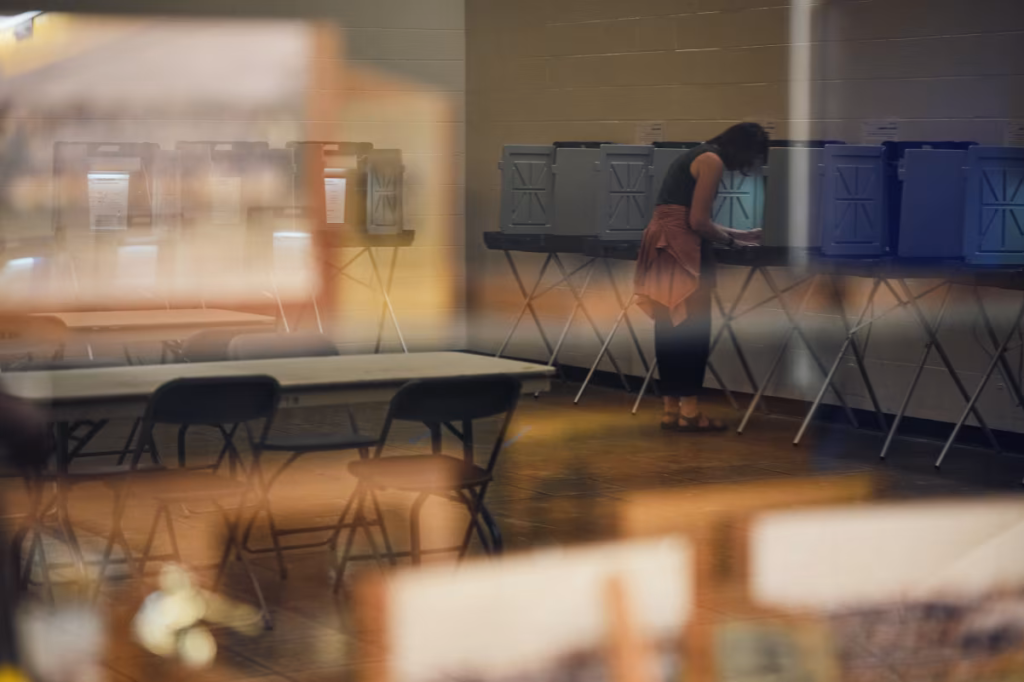
A voter casts her ballot during Minnesota’s primary elections, in Minneapolis, on Tuesday.
Ellen Schmidt/AP
President Donald Trump has sparked fresh constitutional anxiety by refusing to rule out the use of a national security emergency to federalize voting laws ahead of the 2026 midterm elections. The admission suggests the White House may bypass a gridlocked Congress to unilaterally enforce hardline Republican voting measures.
It’s merely the latest warning sign that Trump could try to mess with the election not just by baselessly claiming voter fraud and challenging the results afterward — as he did in 2020, leading to a violent riot at the US Capitol — but by trying to unilaterally take control before votes are cast.
Far-right talk show host Wayne Allyn Root aggressively urged the President to declare a national emergency. Root argued this would allow the administration to enforce photo identification rules, restrict mail-in voting, and require proof of citizenship across all 50 states within the next month—entirely skipping legislative approval. As the controversy erupted during a post-midnight interview on the conservative network Real America’s Voice.
Instead of dismissing the extreme proposal, President Trump offered a cryptic, open-ended response. “Me just say this, stranger things have happened,” Trump replied. “I’ll leave it at that.”
The discussion comes amid severe administration frustration over the Safeguard American Voter Eligibility (SAVE) Act. The White House has continuously championed the SAVE Act as a necessary framework to ensure only American citizens participate in federal elections. While the bill has successfully cleared the House, it has stalled in the U.S. Senate, where Senate Majority Leader John Thune (R-S.D.) and party conservatives agreed to defer action on it until after the August summer recess. However, civil rights organizations and voting groups, such as the Brennan Center for Justice, have fiercely condemned the bill, arguing its strict in-person registration requirements would effectively disenfranchise millions of eligible voters who lack immediate access to certified birth certificates or passports.
Just hours before Trump’s remarks, The threat of a “unilateral voting decree” lands at an already turbulent moment for the executive branch. U.S. District Court Judge Indira Talwani handed down a significant legal defeat to the administration. The judge blocked a previous March 2026 executive order that attempted to draft the U.S. Postal Service into restricting mail-in ballots. “The executive branch has no authority to regulate elections,” Judge Talwani wrote in her ruling, underscoring that the U.S. Constitution strictly delegates election administration to individual states and Congress—not the President. Constitutional scholars are already warning that any attempt by Trump to use national security emergency declarations to mandate voting procedures would trigger immediate, historic legal challenges. Despite the legal roadblocks, Trump’s latest “stranger things” comment signals to his base that the White House remains willing to test the limits of executive power as the high-stakes 2026 midterms draw near.