President Donald Trump’s ongoing challenges involving Iran have renewed attention on his relationship with North Korean leader Kim Jong-un, as Washington appears open to restarting direct communication with Pyongyang.
Trump said Monday that Kim had responded to recent U.S. outreach, although he did not disclose what the North Korean leader had said. His comments followed a decision to reduce the scale of U.S.-South Korean military exercises, with Trump pointing to the expense of the drills as well as his longstanding relationship with Kim.
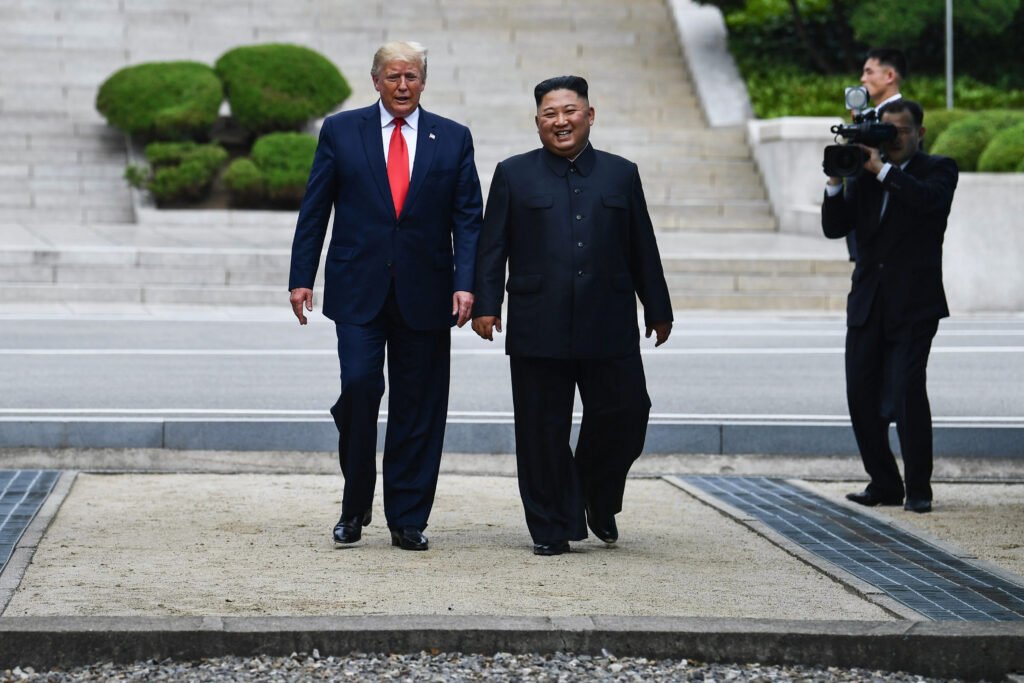
The latest development has revived memories of the unusual diplomacy between Trump and Kim during Trump’s first presidency. The two leaders met at historic summits in 2018 and 2019, holding direct discussions despite years of hostility between Washington and Pyongyang over North Korea’s nuclear weapons and missile programs.
Those meetings generated worldwide attention but ultimately failed to produce a lasting agreement on denuclearization. Despite the lack of a final deal, Trump has continued to speak positively about his relationship with Kim and has indicated that he remains willing to communicate with him.
The renewed attention toward North Korea comes while the Trump administration faces difficult choices over Iran. A deadline associated with a June peace agreement passed without significant progress, leaving major disputes surrounding Iran’s nuclear activities, U.S. sanctions and the strategic importance of the Strait of Hormuz unresolved.
Washington and Tehran remain divided over the future of negotiations, while the possibility of further military confrontation continues to complicate diplomatic efforts. Trump has previously indicated that he would prefer negotiations but has also warned that military pressure could increase if diplomacy fails.
That situation could make North Korea an attractive avenue for another high-profile diplomatic effort. Trump has historically favored direct negotiations with foreign leaders, and his previous encounters with Kim demonstrated his willingness to pursue personal diplomacy even when relations between the two countries were highly strained.
However, restarting talks with Pyongyang would not be straightforward. North Korea has continued developing its nuclear weapons and missile programs and has strengthened its relationships with Russia and China. Those developments could make it considerably more difficult for Washington to persuade Kim to accept restrictions on his nuclear capabilities.
The reduction in U.S.-South Korean military exercises has also attracted attention in Seoul. Such drills are considered important for maintaining military preparedness and demonstrating deterrence against potential North Korean aggression. While some South Korean officials may view reduced exercises as a possible opening for diplomacy, others remain concerned about the impact on regional security.
For Pyongyang, renewed contact with Trump could offer several potential advantages. North Korea has long opposed U.S.-South Korean military exercises and has sought relief from international sanctions. Direct negotiations with the U.S. president could also provide Kim with an opportunity to strengthen North Korea’s international standing.
Yet a new summit is far from guaranteed. North Korea has shown limited willingness to compromise in previous negotiations, while its expanding military capabilities have altered the security environment since Trump and Kim first met.
The timing of Trump’s latest outreach is particularly notable because of the broader foreign-policy challenges facing his administration. With Iran presenting unresolved diplomatic and security questions, renewed engagement with North Korea could give the White House another opportunity to pursue a major international agreement.
Whether communication with Kim develops into substantive negotiations remains uncertain. Trump’s comments suggest that some form of contact may be taking place, but the details of any potential discussions have not been publicly outlined.
The latest developments highlight Trump’s continued preference for leader-to-leader diplomacy when dealing with governments that have historically been viewed as adversaries of the United States. As the Iran situation remains unsettled, his approach toward Kim Jong-un could become an increasingly important part of Washington’s foreign-policy agenda.