
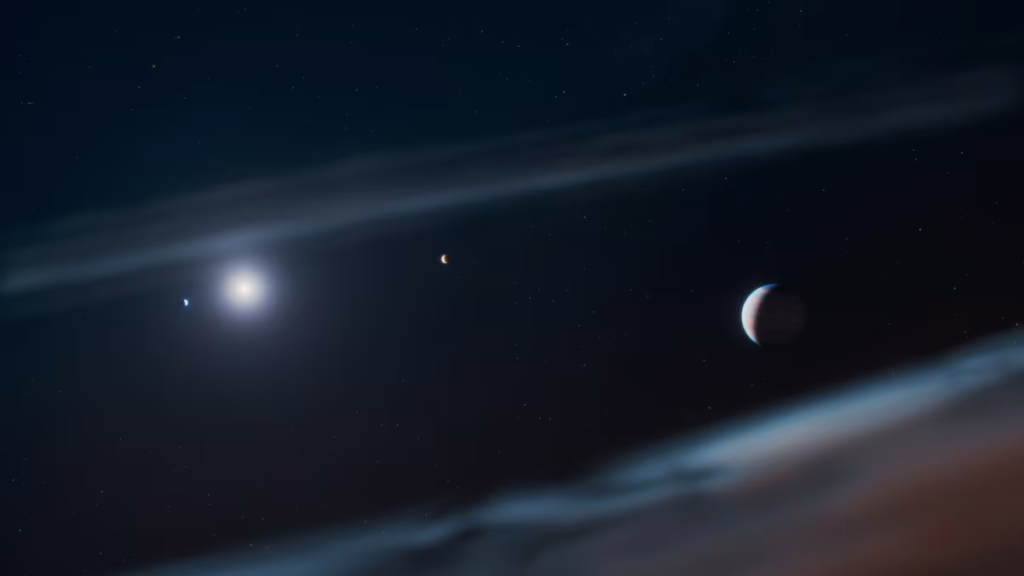
Astronomers have detected radio emissions that appear to originate directly from a planet beyond our Solar System, providing researchers with a new way to investigate the magnetic properties of distant worlds.
The observations were made with the MeerKAT radio telescope array in South Africa and focused on Beta Pictoris b, a large gas-giant exoplanet located approximately 63 to 64 light-years from Earth. Researchers identified repeating radio bursts and persistent emissions that were associated with the planet rather than its parent star.
The observation is notable because previous searches for radio emissions from exoplanetary systems had faced difficulties determining whether detected signals came from the planet or from the star it orbits. In this case, astronomers used the position and movement of the radio source to establish a stronger connection with Beta Pictoris b.
Scientists believe the emissions are associated with auroral activity generated by the planet’s magnetic environment. On Earth, auroras occur when charged particles interact with the planet’s magnetic field and atmosphere, producing the familiar displays known as the Northern and Southern Lights.
A similar process can occur on other planets. According to researchers, energetic electrons moving through a magnetic field can generate concentrated radio waves through a mechanism called electron cyclotron maser instability.
The MeerKAT observations covered frequencies from roughly 0.85 to 3.5 gigahertz. The characteristics of the detected emissions were consistent with radio waves generated through magnetic interactions rather than a technological transmission.
The findings also provide an opportunity to estimate the strength of Beta Pictoris b’s magnetic field. Based on the highest-frequency radio emission observed, researchers estimate that the planet’s magnetic field is at least around 1,250 gauss.
That would represent a considerably stronger magnetic field than Earth’s and would also exceed the magnetic field strength associated with Jupiter. Measurements of planetary magnetic fields can give scientists information about the internal structure of planets and how they interact with the surrounding environment.
Beta Pictoris b itself is a young and massive gas giant and is not regarded as an Earth-like habitable planet. It does not have a solid surface comparable to Earth. Nevertheless, its radio emissions could help researchers develop techniques that might eventually be applied to smaller exoplanets.
Magnetic fields are particularly interesting to astronomers because they can influence how a planet responds to radiation and charged particles released by its host star. A strong magnetic field can also affect the behavior and long-term evolution of a planetary atmosphere.
The discovery does not constitute evidence of an alien civilization or an artificial communication signal. Researchers say the observed radio emissions have a natural explanation associated with auroral processes and the planet’s magnetic field.
Instead, the significance of the finding lies in the possibility of using radio observations as another method for studying planets located far beyond the Solar System.
Most exoplanets are investigated through techniques such as measuring changes in a star’s brightness or detecting the small gravitational movement caused by an orbiting planet. Radio astronomy could add another layer of information by revealing magnetic activity that cannot necessarily be measured through those conventional methods.
Future observations could help astronomers determine whether similar radio emissions are present around other exoplanets. Researchers may particularly be interested in applying the technique to planets with different sizes, compositions and distances from their host stars.
The study is also expected to undergo further scientific examination and follow-up observations. Independent measurements will be important for confirming the findings and refining estimates of Beta Pictoris b’s magnetic field.
If the observations are confirmed, the work could represent an important step for radio astronomy and exoplanet research. Rather than simply identifying distant planets, astronomers may increasingly be able to investigate their magnetic environments and learn more about how these worlds behave.
The detection therefore offers a new perspective on a planet located dozens of light-years away, showing how radio observations can reveal previously inaccessible details about worlds beyond our Solar System.
You can watch the video below