
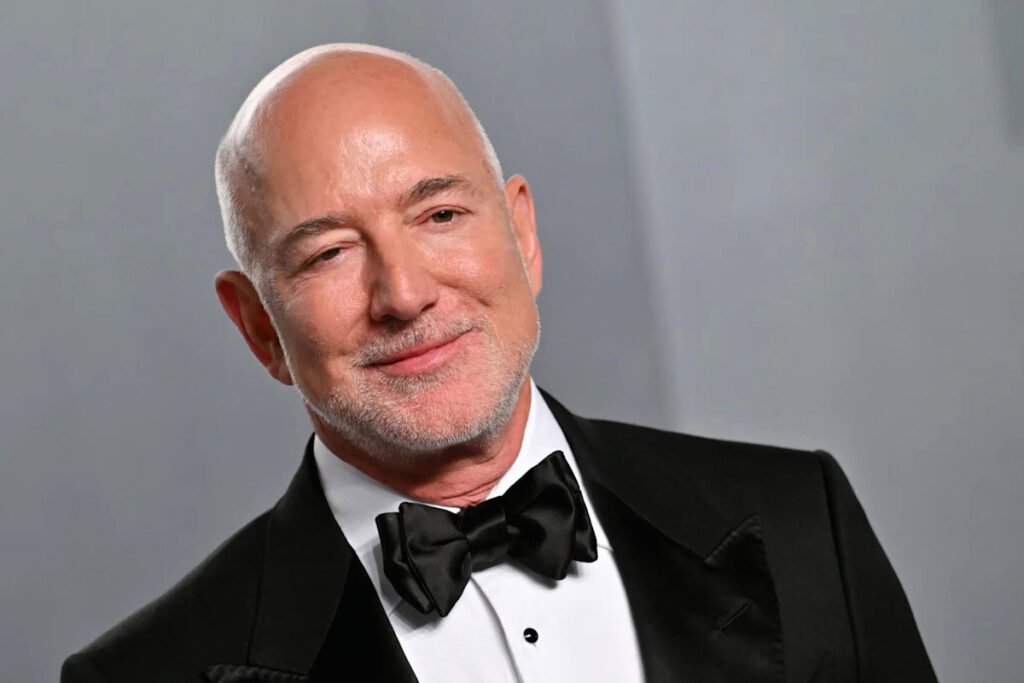
Amazon founder Jeff Bezos has pushed back against criticism of wealthy entrepreneurs, arguing that achieving financial success should not automatically lead to public condemnation. During a recent interview with Fox News, Bezos questioned the tendency to portray billionaires negatively and emphasized the role businesses can play in creating jobs, developing products and contributing to economic growth.
Bezos argued that some people have been encouraged to view success through an unfair lens, suggesting that building a profitable company should not be treated as wrongdoing. He maintained that entrepreneurs can create substantial wealth by offering products and services that customers genuinely want.
His comments have renewed discussion about the relationship between business success, economic opportunity and the growing debate over wealth inequality in the United States.
To illustrate his argument, Bezos described how a simple hamburger stand could eventually grow into a large restaurant business. A small operation that attracts customers could expand into multiple locations, employ more workers and generate significant revenue over time.
He also referred to Raising Cane’s, a fast-food chain known for its chicken-finger meals, as an example of a business that developed by appealing to consumers.
According to Bezos, entrepreneurs should not be criticized simply because their businesses become successful. He argued that providing products people appreciate and are willing to purchase can form the foundation of legitimate commercial achievement.
His perspective reflects his own experience building Amazon from an online bookstore into a global company operating across e-commerce, cloud computing and other industries. He has also pursued ambitious projects through Blue Origin, his space exploration company.
Bezos’ remarks come as Americans continue debating the concentration of wealth and the economic challenges confronting ordinary households.
Critics of billionaire fortunes argue that extreme wealth inequality raises concerns about access to opportunities, taxation and the influence wealthy individuals can exercise over public policy. They also question whether the benefits generated by large businesses are distributed fairly among workers, consumers and investors.
Supporters of entrepreneurship, however, argue that successful companies can stimulate economic activity, introduce new technologies and provide employment to millions of people.
Bezos’ position challenges the assumption that financial success itself should make an entrepreneur a target of criticism. He suggests that public discussion should focus on addressing economic problems rather than assigning blame to people simply because they have accumulated wealth.
Nevertheless, the debate involves more than whether a business becomes profitable. Questions surrounding wages, working conditions, market competition and the distribution of economic gains remain important considerations when assessing the broader impact of large corporations.
While defending entrepreneurs, Bezos also acknowledged the financial pressures facing many Americans, particularly younger people struggling with housing costs.
He discussed the difficulty of finding affordable places to live near employment opportunities and argued that policymakers should examine the underlying causes of rising prices.
Housing supply and restrictions that limit construction can contribute to affordability problems in some markets. Addressing these challenges may require examining local regulations, building capacity and other factors affecting the availability of homes.
Bezos encouraged a focus on practical solutions rather than political rhetoric. His argument was that identifying the causes of economic difficulties is more useful than simply blaming wealthy individuals or businesses.
However, housing affordability is a complex issue, and its causes vary across communities. Policy discussions also involve wages, financing costs, infrastructure and local demand.
Bezos’ comments reinforce his belief that entrepreneurship should be recognized for its potential to create value, generate employment and expand economic opportunities.
His argument does not eliminate concerns about wealth inequality or corporate responsibility. Instead, it highlights a continuing disagreement over how society should evaluate people who build highly profitable businesses.
For Bezos, becoming wealthy through a successful enterprise should not automatically carry a negative moral judgment. He maintains that public attention should remain on whether businesses provide useful products and services and whether policymakers are addressing the economic challenges affecting households.
As discussions about billionaires, taxation and affordability continue, his remarks add another perspective to the debate over the role of private enterprise in American society. The central question remains how to encourage innovation and business growth while ensuring that economic opportunities and benefits are broadly accessible.
You can watch the video below