
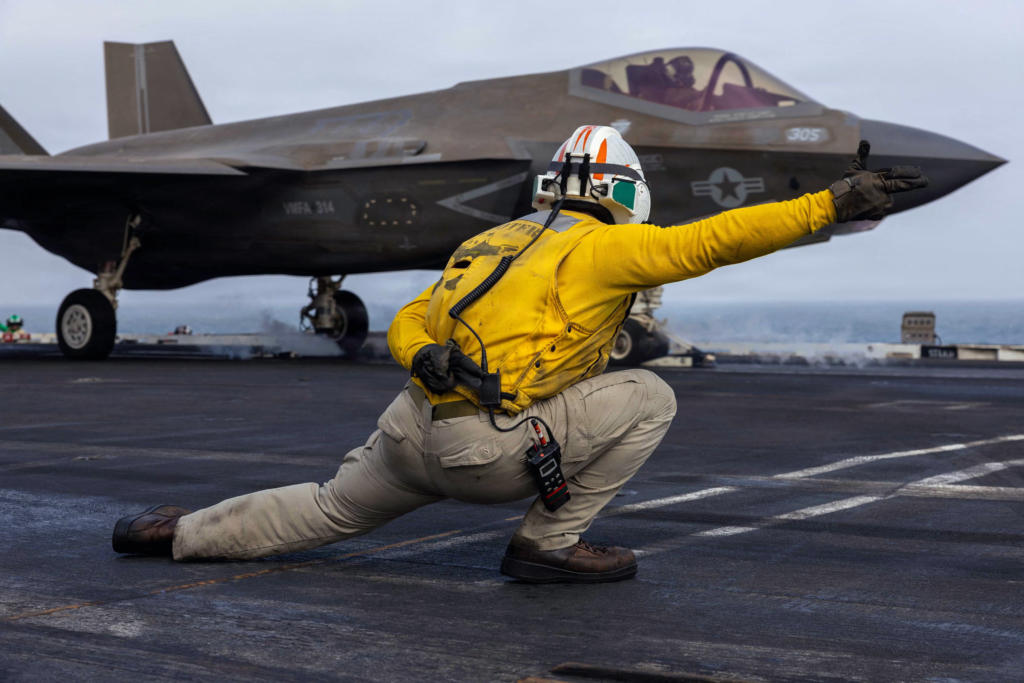
After nearly a decade of loudly complaining about the fact that modern US aircraft carriers use electromagnetic systems to launch fighter jets instead of steam-powered catapults, Donald Trump has directed the Pentagon to redesign a new aircraft carrier to replace the modern system with the old-fashioned catapults he prefers.
Trump signed a national security memorandum on Thursday directing the defense secretary, Pete Hegseth, and the acting navy secretary, Hung Cao, to make the change he has had his heart set on since at least 2017, when he first described his idea to Time magazine.
The memorandum gives the Pentagon leaders 60 days to come up with “a plan on the required measures to replace the Electromagnetic Aircraft Launch System and Advanced Weapons Elevators with steam and hydraulic systems for the construction of” the USS Doris Miller, a Ford-class aircraft carrier, which is already two years behind schedule.
“You know the catapult is quite important,” Trump told Time magazine in 2017 before recounting a conversation he said he had with an unnamed navy officer.
“So, I said, ‘What is this?’ ‘Sir, this is our digital catapult system'”, Trump went on. “It sounded bad to me. Digital. They have digital. What is digital? And it’s very complicated, you have to be Albert Einstein to figure it out. And I said—and now they want to buy more aircraft carriers—I said, ‘What system are you going to be’—’Sir, we’re staying with digital.’ I said, ‘No you’re not. You’re going to goddamned steam, the digital costs hundreds of millions of dollars more money and it’s no good’.
A Guardian review of Trump’s public remarks shows that he has retold that story, with variations, every year since 2017.
In 2018, Trump brought it up during a Thanksgiving day phone call with the commanding officer of the USS Ronald Reagan, an aircraft carrier docked in Hong Kong at the time. In 2019, he recounted his conversation with the “catapulter” to Republican donors at a fundraiser. In 2020, as the nation was grappling with a pandemic, the tale became a regular part of Trump’s campaign speeches. In 2021, he told the story at the CPAC convention. In 2022, he shared it in a campaign speech in Texas. He repeated it on the campaign trail in Iowa in 2023. At one of his final campaign events before the 2024 election, Trump told Tucker Carlson the same story.
After he returned to office in 2025, Trump brought up steam catapults during the swearing-in of Tulsi Gabbard as his director of national intelligence and did so again in remarks to the crew of the USS George Washington, an aircraft carrier based in Japan.
“We built an aircraft carrier for $19bn, which is crazy, The price is crazy,” Trump recalled last month at the Army War College in Pennsylvania. “It had all sorts of modern-day things that were all – instead of using steam for the catapults, they used electric.
“So, when I went to the ship, because I came into office and the ship was way over budget, built in Newport News [Virginia],” Trump continued. “I said: ‘I want to meet the catapulter,’ and a man came over, along with four of his assistants. And I said: ‘What’s better: electric catapult or steam?’ He’s been there for 25 years. He said: ‘Steam is better, sir. We can fix it with a hammer and a blowtorch. When the electric goes bad, I have to send to MIT to get geniuses over here.’ I said: ‘Steam is better?’ ‘Yes, sir it’s better.
“According to the Wall Street Journal, which first reported the order, senior US navy and industry leaders “have resisted the move due to the enormous expense of tearing out such a complex system that was integral to the design” of the latest aircraft carriers.
President Donald Trump’s national security memorandum represents a definitive policy victory for his long-standing campaign against digital naval infrastructure, forcing a major technological reversal despite nearly a decade of institutional resistance. By ordering the Pentagon to replace the Electromagnetic Aircraft Launch System (EMALS) and Advanced Weapons Elevators with traditional steam and hydraulic systems on the USS Doris Miller, the directive fundamentally reshapes the future of the Ford-class carrier program. While the administration favors the mechanical reliability and simpler repair protocols of analog technology, senior Navy and defense industry leaders warn that tearing out integrated digital systems will yield severe consequences. Ultimately, this mandate is projected to incur billions of dollars in redesign costs, heavily compound existing construction delays, and elevate required shipboard staffing levels at a time when global naval forces are actively transitioning toward automation.